
Armenia, Country #90: Ararat at Sunset, Garni and an Abandoned Soviet Telescope
My 90th country started with a laptop in a café and ended, the next evening, at the control desk of a Soviet telescope nobody has used since 2012. In between: a pink sunset over Mount Ararat, a church cut into a cliff and a gorge lined with stone columns so regular they look man-made. Armenia was the last stop of the Road to 90 trip, and the only one where I had company: Bohdan, a Ukrainian traveller who covers most of his trips by hitchhiking.
The Air Arabia flight from Sharjah landed in Yerevan on October 19 at 11:15. An hour later I had a rental car for 2 days, and on October 21 I flew home.
Armenia has about 3 million people and was the first country to adopt Christianity as its state religion, traditionally dated to 301 AD. Fun fact: Yerevan grew out of the fortress of Erebuni, founded in 782 BC — 29 years before the legendary founding of Rome.
Yerevan, the part I saw
Right after Baku, Armenia felt much simpler. More Soviet, less organized, and in places it looked like nobody was taking care of the city. There are parks, and overall Yerevan is in decent shape, but I walked around the area near English Park (not the park itself), and that was not pleasant: underpasses with litter lying around, and a smell of urine in a couple of spots. It left me with a slightly shabby impression of the city.
To be fair, I didn't see central Yerevan at all. No Opera House, no France Square next to it, no Republic Square. With a car and only 2 days I spent them outside the city, so take my Yerevan impressions with a big grain of salt.
Half a day of work at 9am Coffee & More
October 19 was a working day, so before any sightseeing I sat in a café on my way into the city, 9am Coffee & More. Wi-Fi worked, it was comfortable to sit with a laptop for hours, and the staff were friendly — some spoke Russian, some English. The only problem was parking: I spent about 20 minutes looking for a spot and finally left the car in a courtyard 10 minutes' walk away.
Khor Virap at exactly sunset
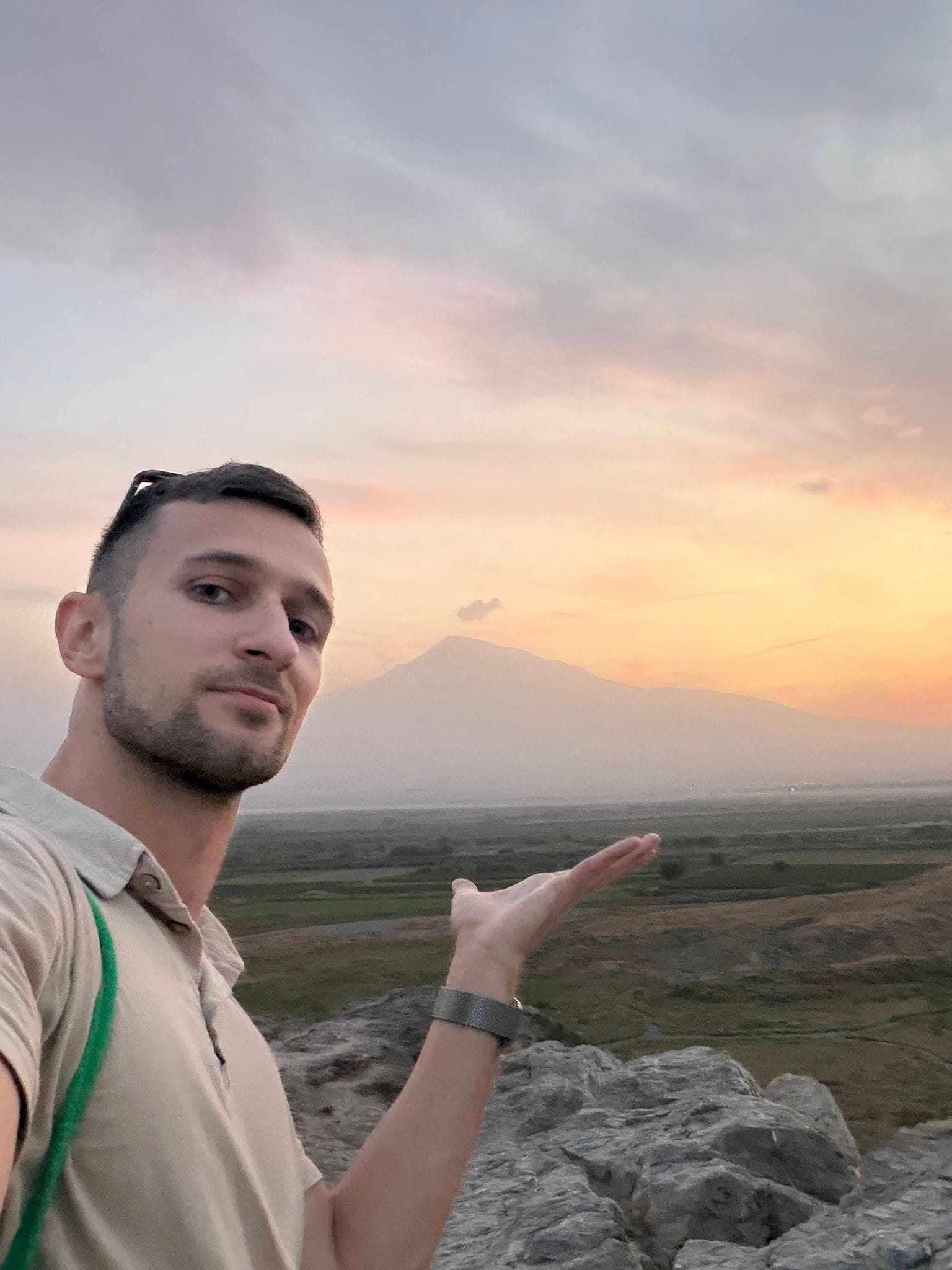
After work I drove south to Khor Virap, the monastery with the classic close-up view of Mount Ararat. Tradition says King Tiridates III held Gregory the Illuminator in a pit here for 13 years; afterwards Gregory converted the king, and Armenia with him. The pit is still there, about 6 m deep, and you can climb down into it. The monastery stands about 100 m from the closed Turkish border, and the 5,137 m summit of Ararat is roughly 30 km away, in Turkey.
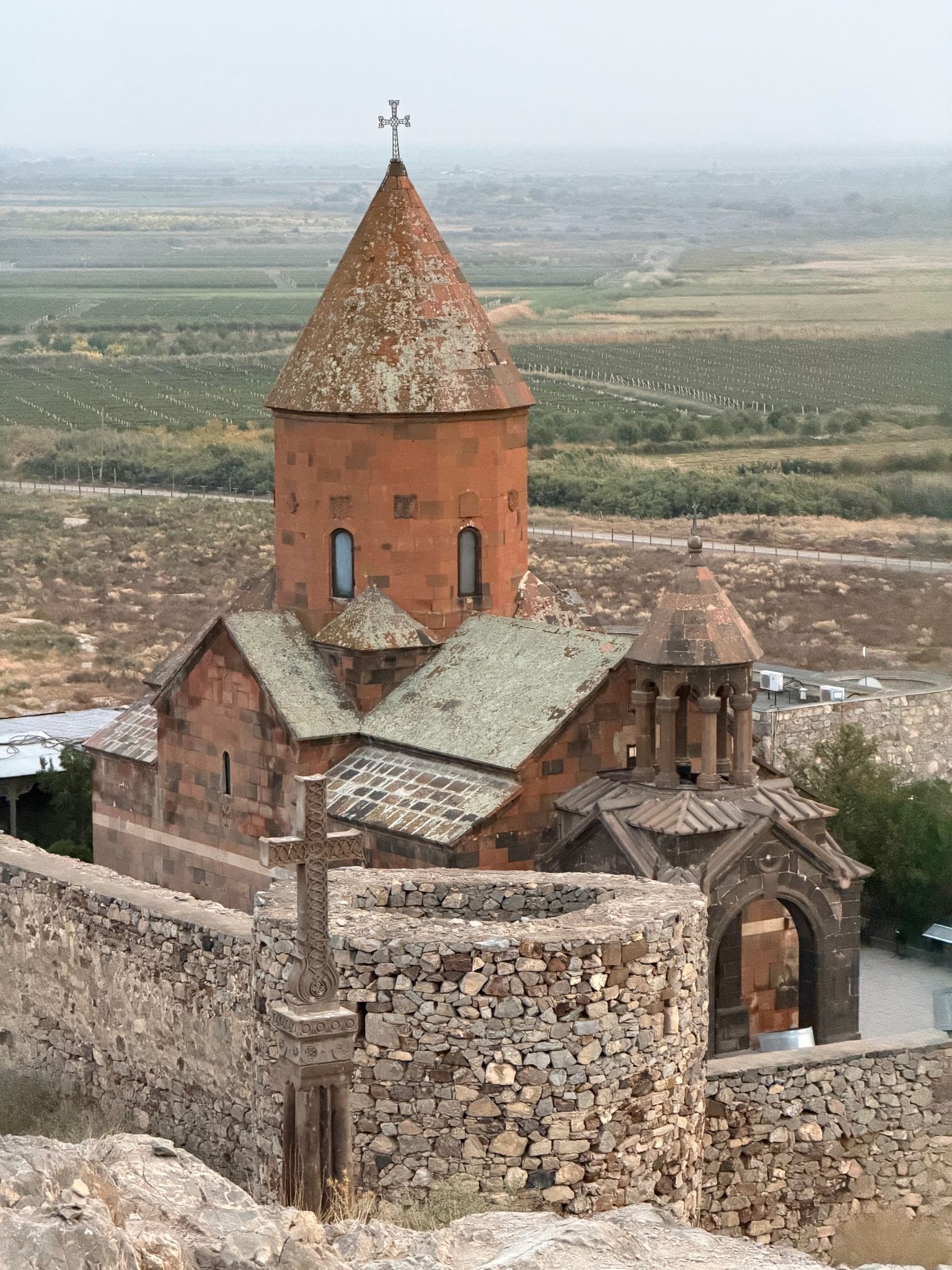
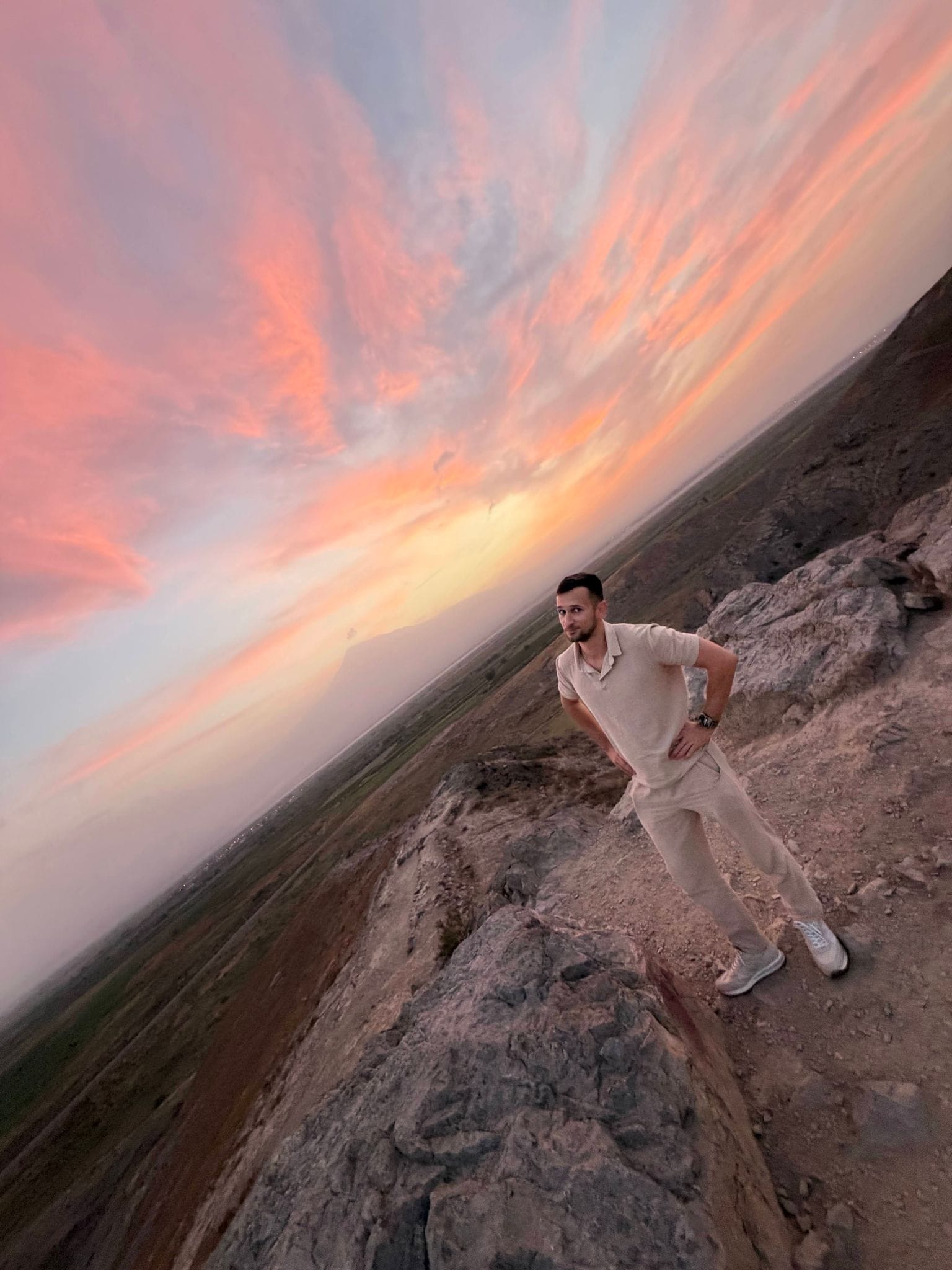
I arrived at exactly sunset, and I'm glad I didn't skip it. Ararat wasn't perfectly clear, but it was visible enough for good photos, and the sky turned very pink.
Bohdan, who hitchhikes 6–8 cars a day
The next day I travelled with Bohdan, a friend I knew from Instagram. He's Ukrainian like me, has been to 70-something countries — a bit fewer than me — and travels on a very different budget: he hitchhikes, stays with people through Couchsurfing, and his trips cost him almost nothing except food.
I asked how hitchhiking actually works. To get to a place and back he might ride in 6–8 cars a day. He catches a car and quickly reads whether the driver wants to talk — some don't, some clearly do. Some days you're lucky. Other days a car stops, takes you 5 or 10 km and turns off, and you start again. And sometimes one driver takes you all the way.
Karabakh, as I heard it
Bohdan passed on a lot of what locals had told him. The two countries fought over Nagorno-Karabakh for decades. In the 44-day war of 2020 about 3,800 Armenian soldiers were killed. In September 2023 a one-day Azerbaijani offensive ended it: by early October over 100,000 people, almost all Karabakh Armenians, had fled to Armenia. From what I heard, new housing is being built for them, but many Armenians still don't accept that they were simply moved out.
You see it on the road. In villages and small towns I passed billboards with portraits of soldiers who died in Karabakh; as I understood, families buy the space themselves.
The peace process is not finished either. A treaty was initialled at the White House in August 2025, but as of October 2026 it isn't signed: Azerbaijan wants Armenia to remove the Karabakh reference from its constitution, which needs a referendum. The mood I picked up was not friendly, and I'd be surprised if this story were over.
The way Bohdan and the locals he talked to see it, and I agree: the roots go back to the Soviet Union, and today's Russia keeps setting the two countries against each other, because it doesn't need strong neighbours on its border. I can't judge how much of that is the whole truth. But it's a fact that the roughly 2,000 Russian peacekeepers deployed after the 2020 war didn't stop the 2023 offensive, and left Karabakh in June 2024.
Geghard: a church cut into the rock
Our first stop was Geghard. Bohdan had a drone, and that turned out to be a gift: I travelled without mine, because three countries on this trip — Kuwait, Azerbaijan and Bahrain — either ban drones or make them impossible for a tourist, so there was no point in carrying one just for Armenia. Every aerial shot in this post is from Bohdan's drone.
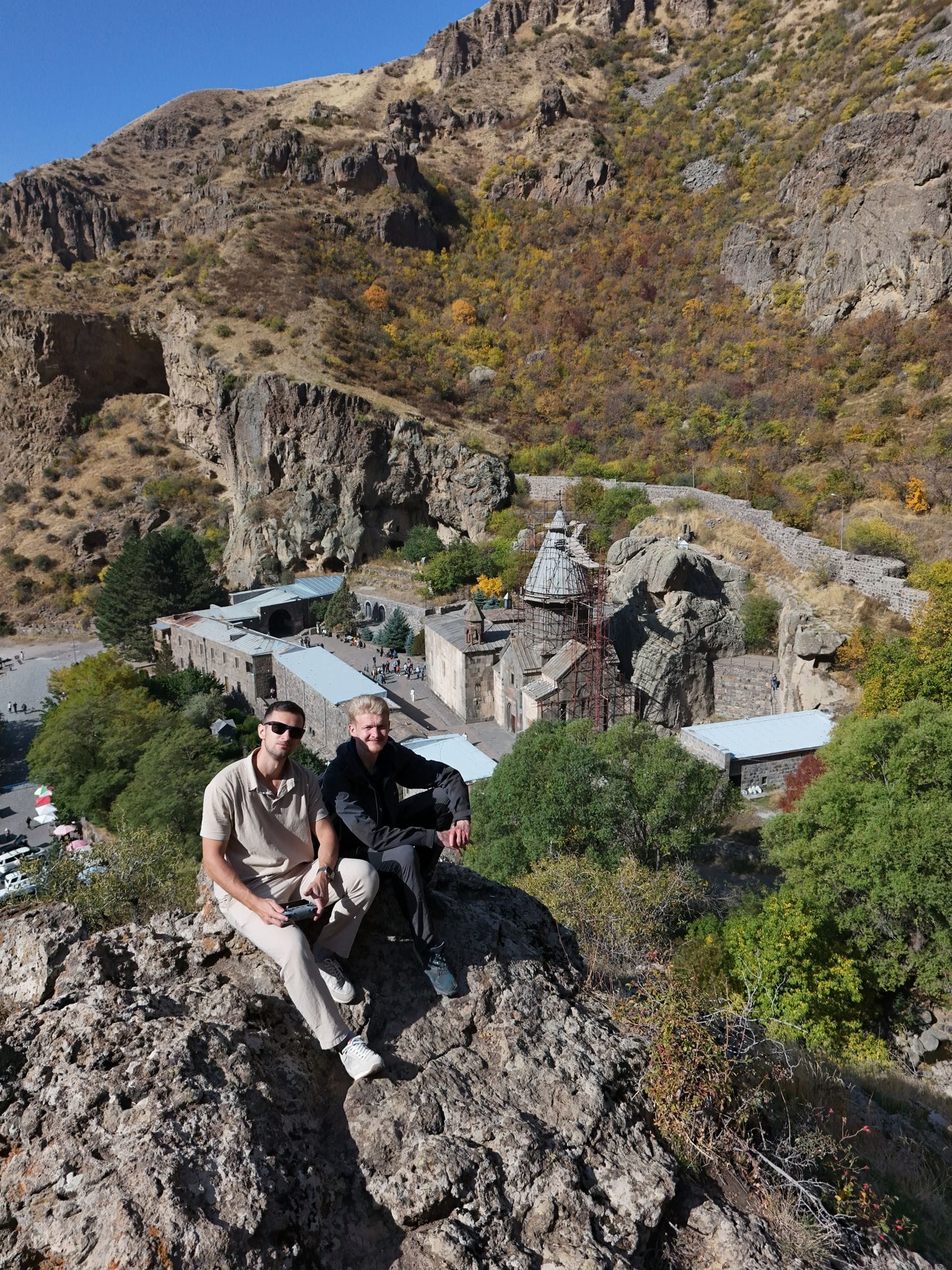
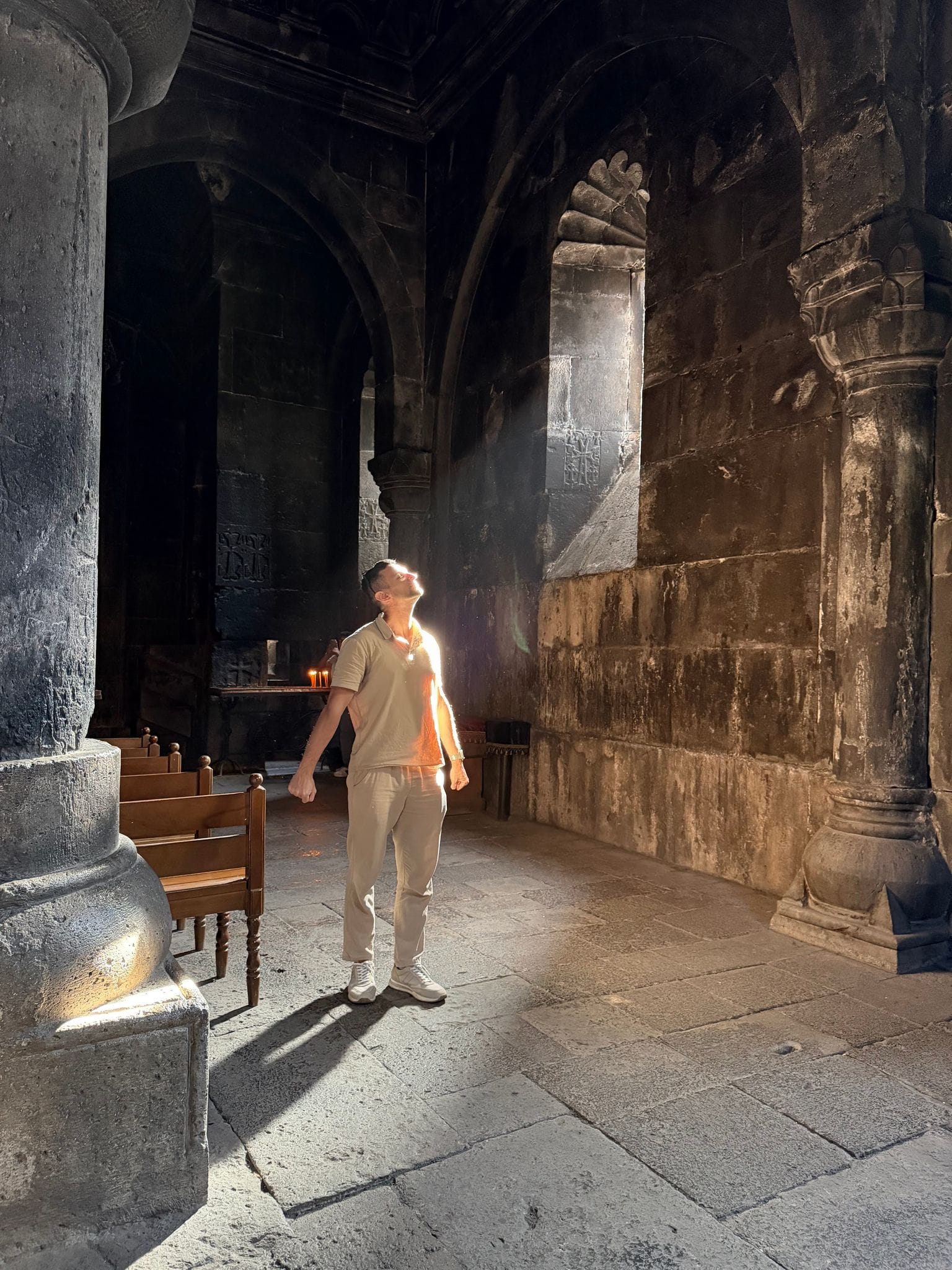
Geghard is a monastery where part of the church is carved straight into the cliff. From the inside it looks a bit like our Christian churches at home, except that everything around you is solid stone, and that impressed me a lot. The site goes back to the 4th century; the main church dates to 1215, and the rock-cut churches were carved in the 1240s–1280s. It has been a UNESCO site since 2000. Fun fact: "Geghard" means "spear" — the monastery once kept the Holy Lance, which is now in Etchmiadzin.
Garni gorge: how lava turned into columns
Below the Garni temple there's a sight I liked even more: the Garni gorge, also called the "Symphony of Stones". Its walls are made of stone columns — mostly five- and six-sided, standing side by side like organ pipes.
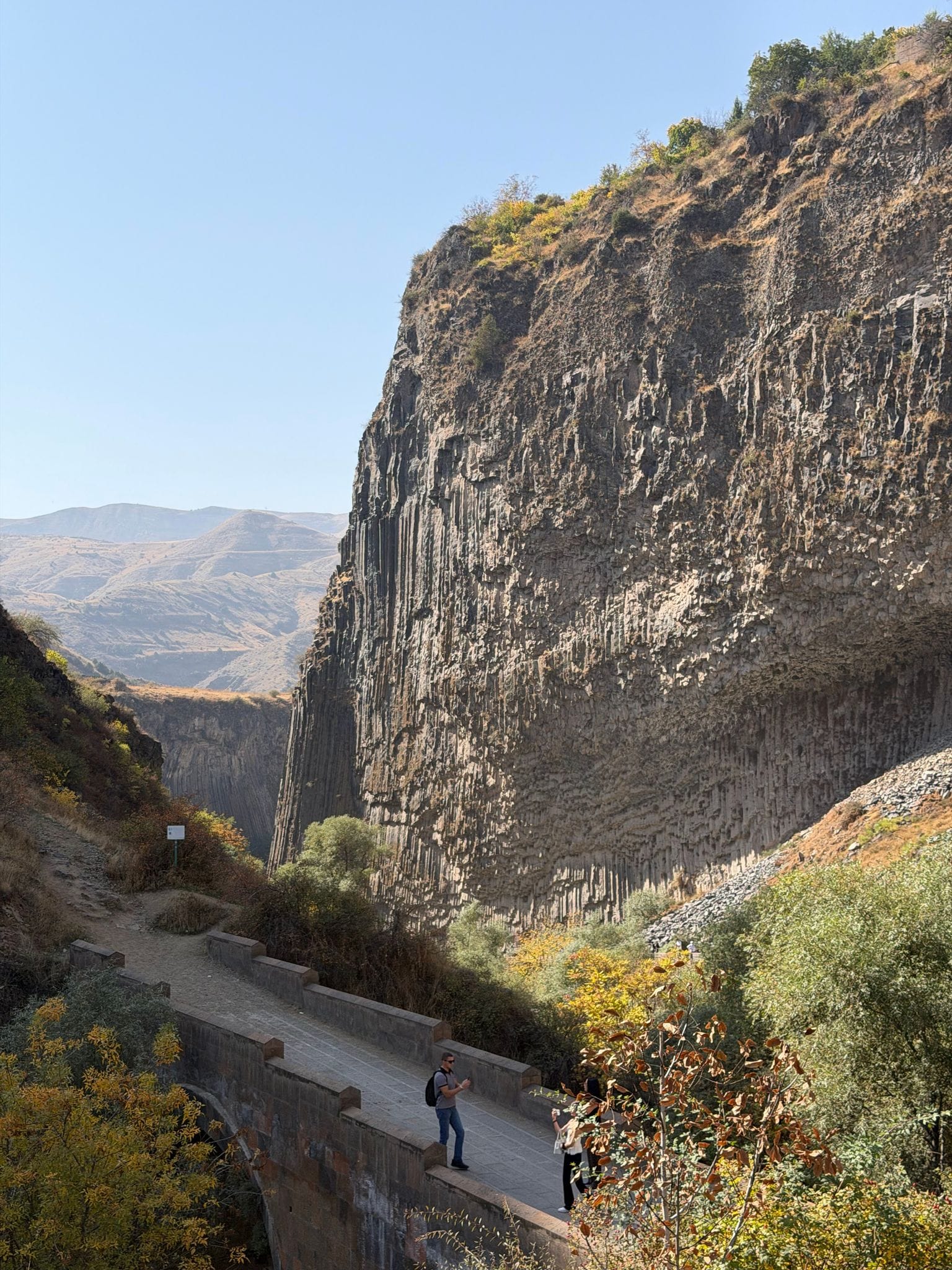
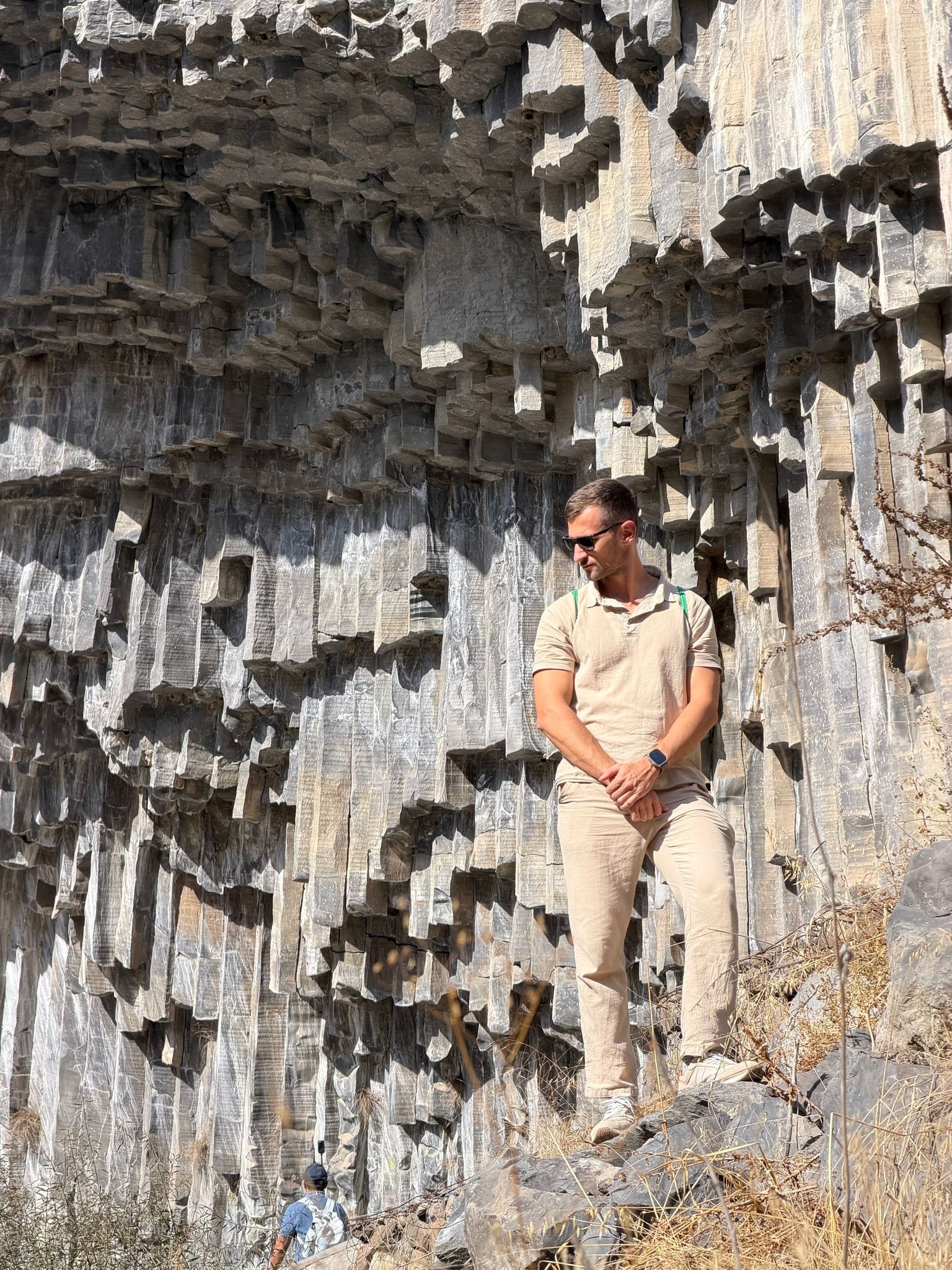
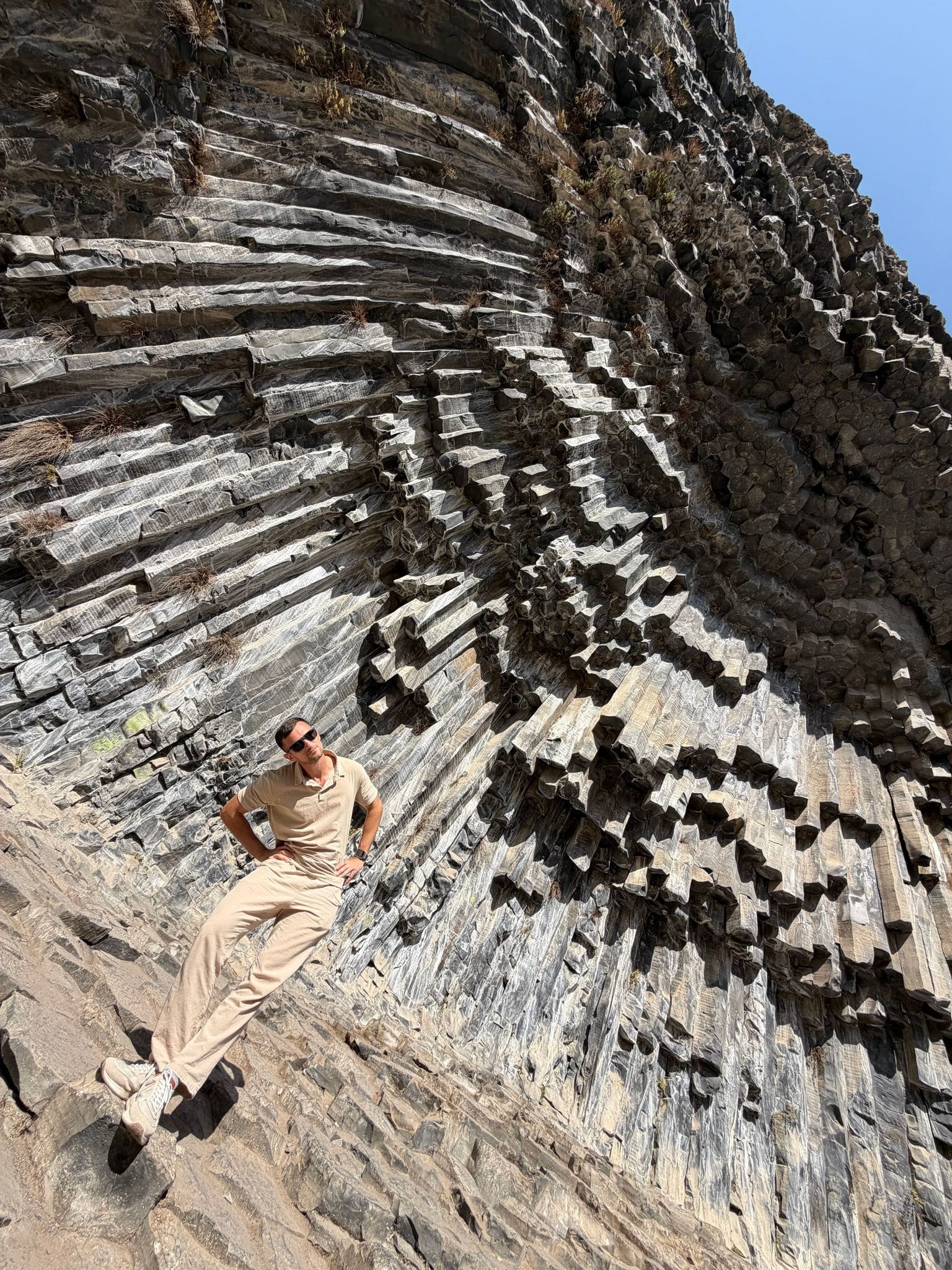
Only there did I learn why they look like this. Basalt lava filled the valley and cooled slowly, from the top and from the bottom. Cooling rock shrinks, and the shrinking crust cracks into a network of polygons. The cracks follow the cooling fronts deeper and deeper, splitting the whole flow into long prisms. Geologists call it columnar jointing. Much later the river cut through and exposed them.
Nobody carved the Garni columns: cooling lava shrinks and cracks into polygons, and the cracks grow into prisms.
In places the columns bend into a fan, and I couldn't resist lying down under one. An epic place.
Garni Temple and the Charents Arch
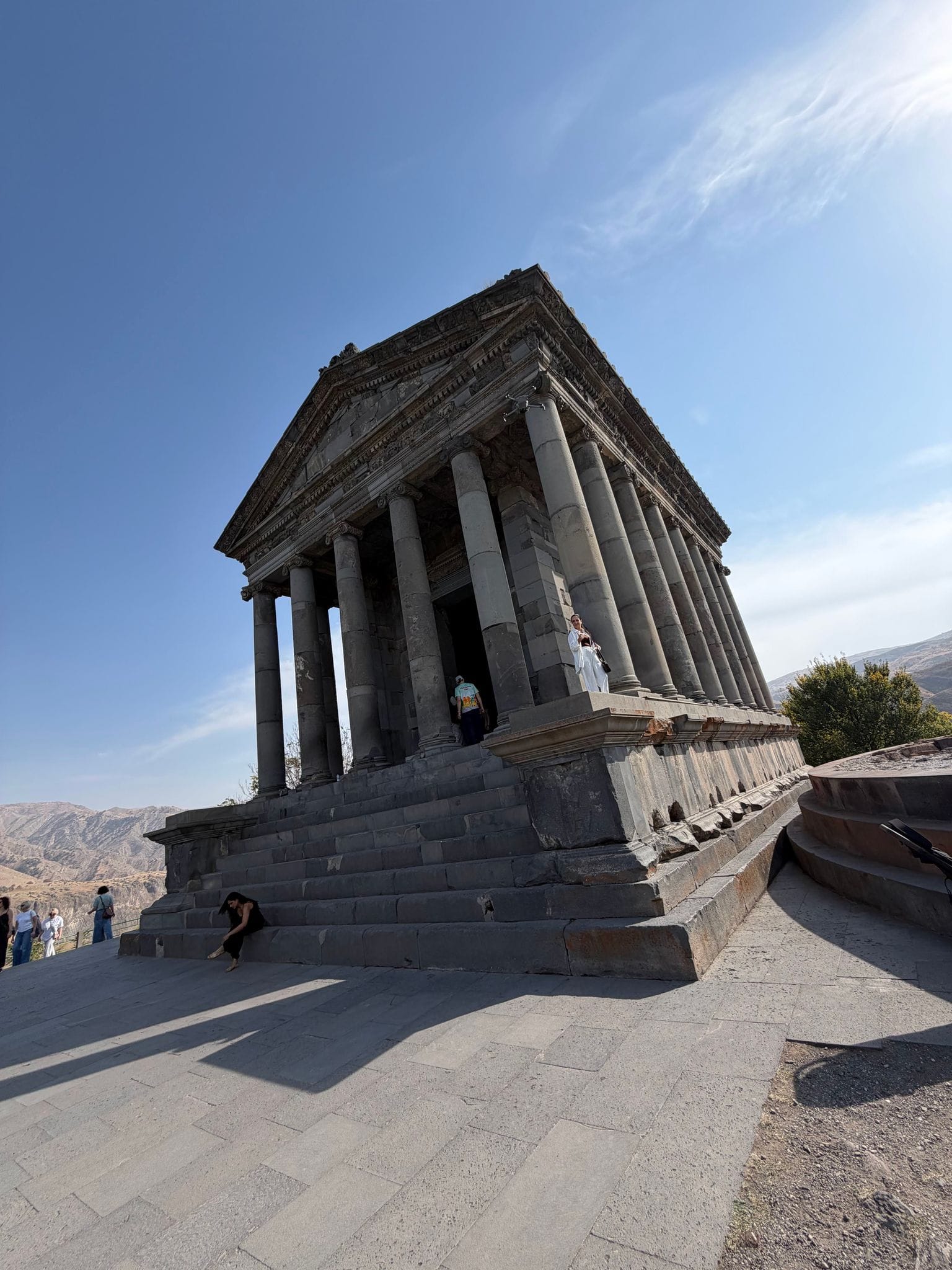
Garni Temple sits on the edge of the gorge. It's a Greco-Roman temple usually dated to about 77 AD, often called the only standing building of its kind in the former Soviet Union. An earthquake brought it down in 1679, and it was rebuilt from the original stones in 1969–1975.
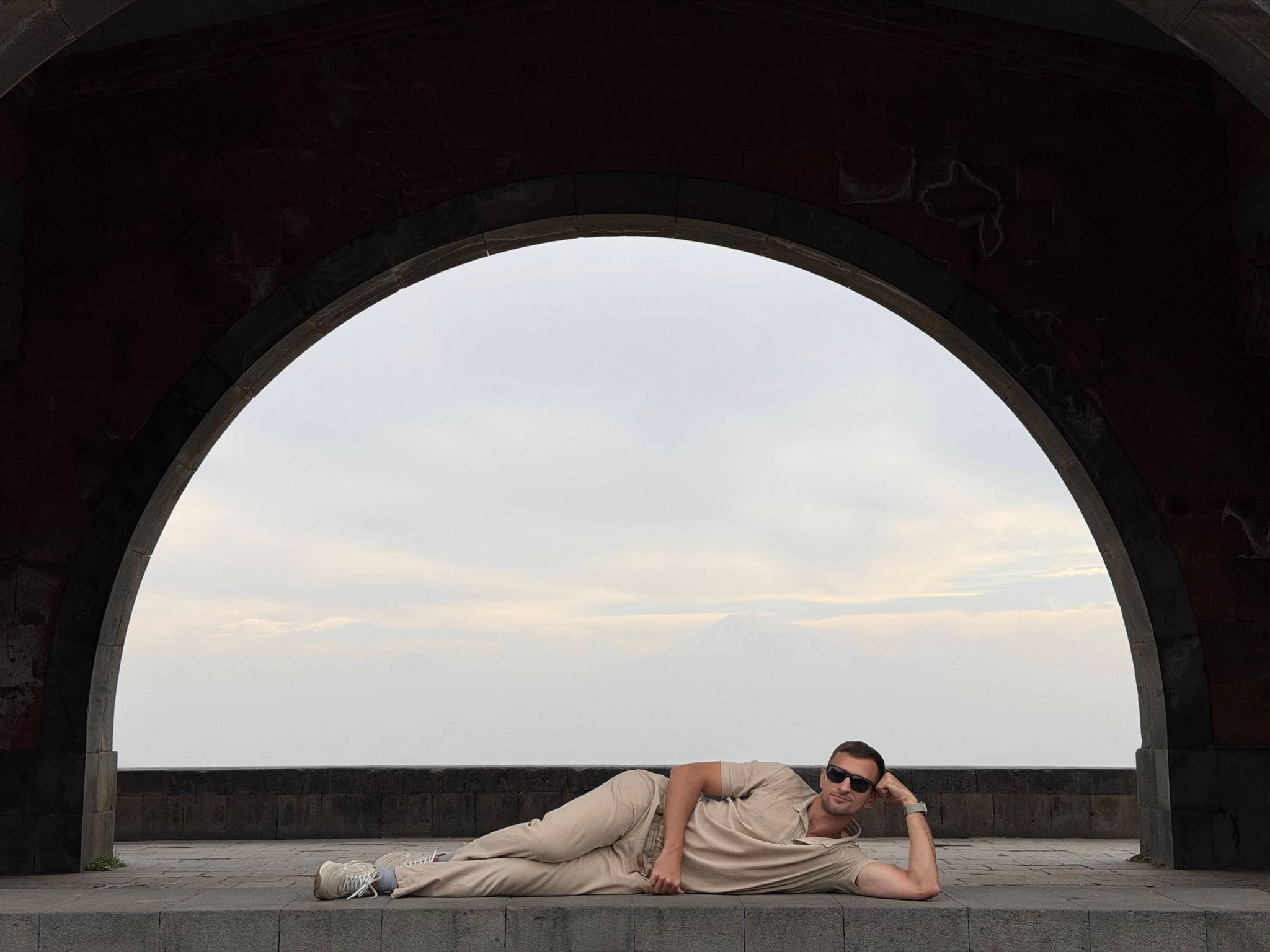
On the way back we stopped at the Charents Arch, a 1957 monument to the poet Yeghishe Charents that frames the view of Ararat. That afternoon the mountain was hiding in the haze, so the arch framed me instead :)
ROT-54: the abandoned Soviet telescope
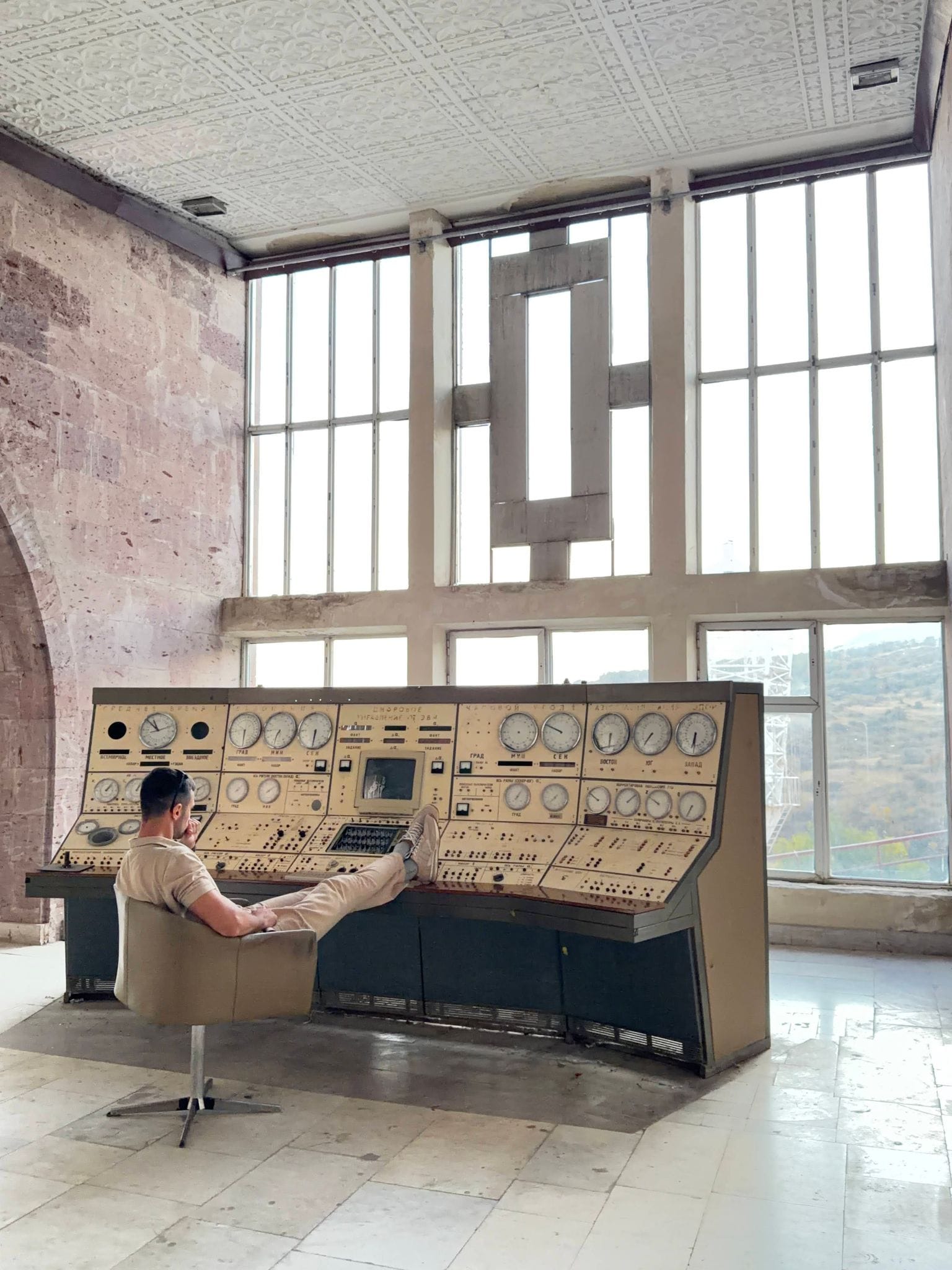
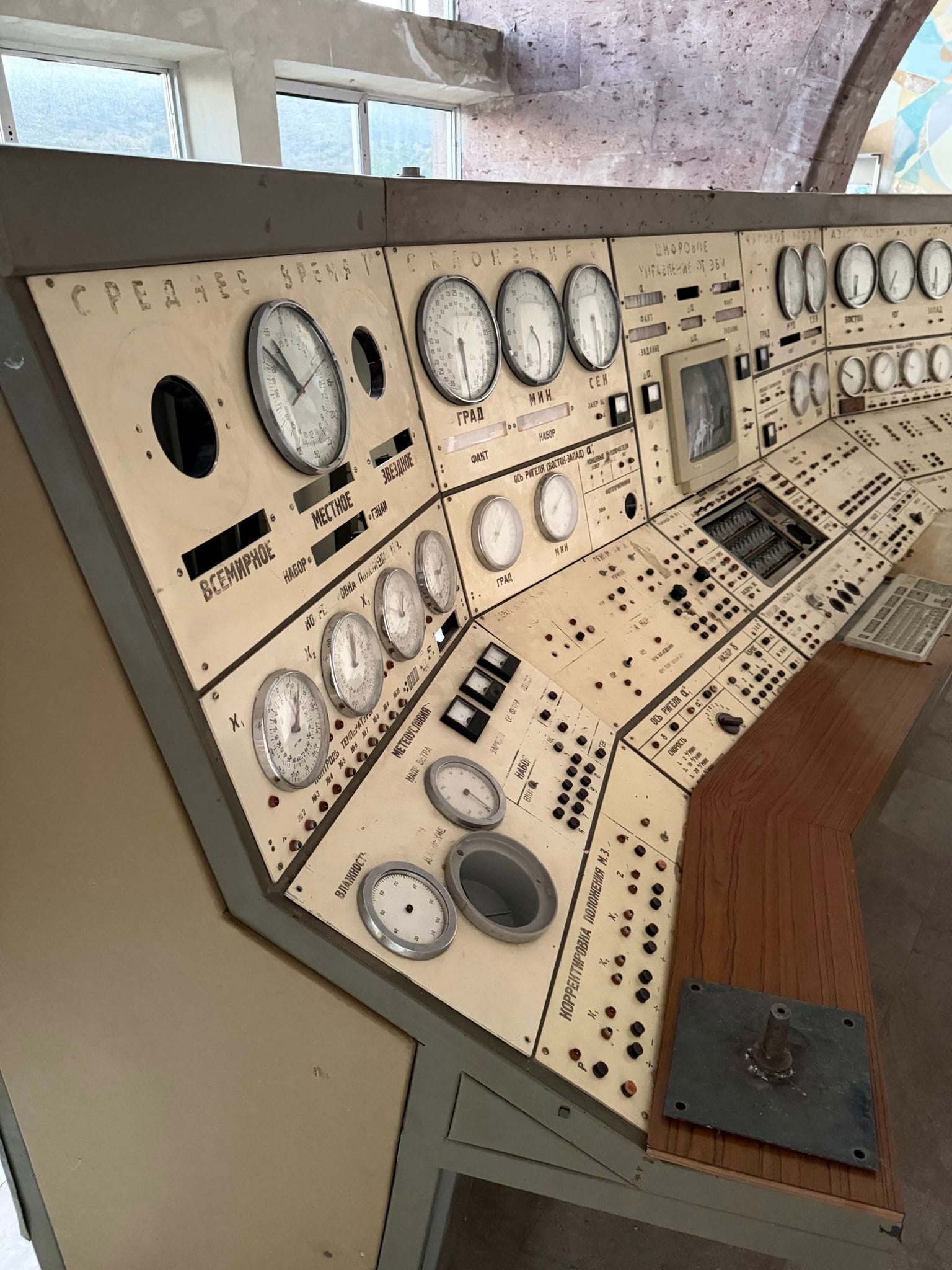
For me personally, the most interesting place was the ROT-54/2.6 radio-optical telescope near the village of Orgov, on the slopes of Mount Aragats. It's abandoned but quite touristy: you can walk around, and a lot of Soviet-era equipment is still there.
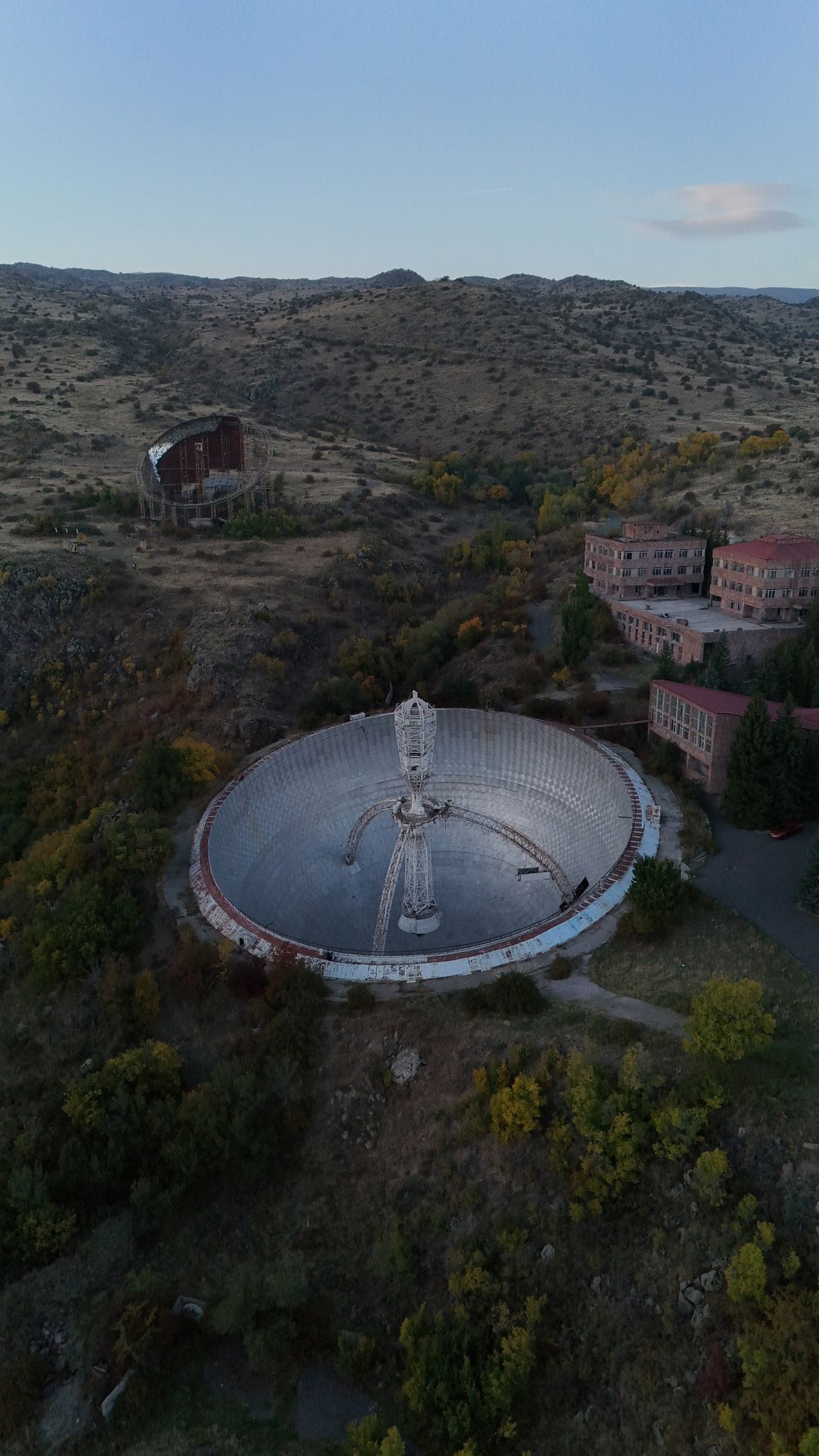
The scale got me. The dish is 54 m across and doesn't move: it's built into the ground at 1,711 m, and a movable secondary mirror hangs above it. The idea came from the Armenian physicist Paris Herouni in 1964; the telescope was built in 1975–1985 and started working in 1986. It ran until about 1990, worked again from 1995 to 2010, and stopped for good in 2012, when the arm that controls the secondary mirror broke. Today it's mothballed.
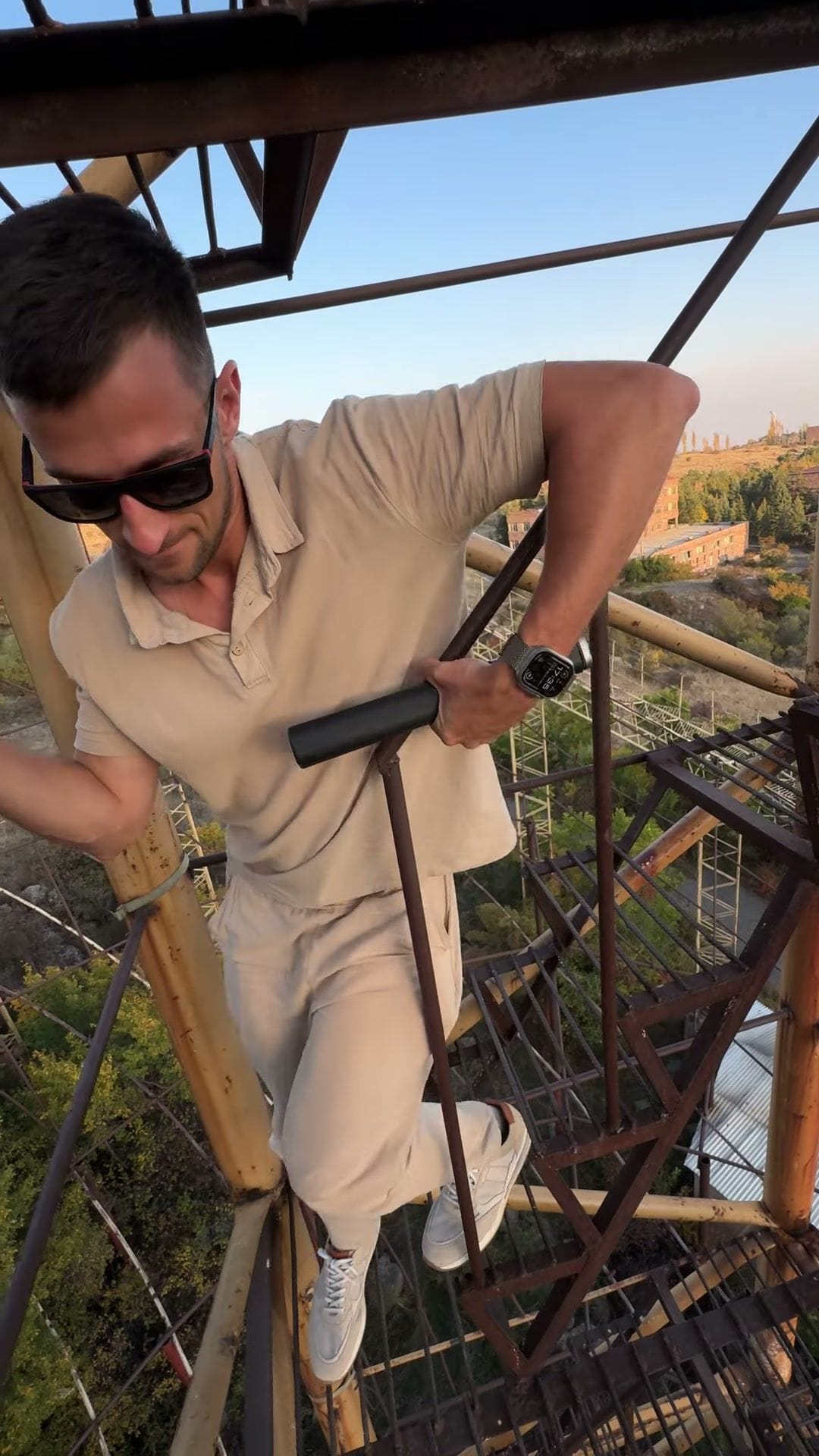
We climbed the steel frame above the mirror panels and filmed a lot.
Inside, the control room looks like the staff left for lunch decades ago.
I'm editing a reel from there for my Instagram.
Practical Notes
- Visa: Armenia was visa-free on my Ukrainian passport.
- Car rental: I booked a car online and picked it up at Yerevan airport. With a car, Khor Virap, Geghard, Garni and ROT-54 fit into a day and a half instead of separate tours.
- Parking in Yerevan: plan extra time. I spent about 20 minutes finding a spot near the café.
- Language: Russian and English both worked for me; at the café some of the staff spoke one, some the other.
- Drones: allowed in Armenia (with occasional temporary bans), unlike Kuwait, Azerbaijan or Bahrain on the same route.
- Lounge at Zvartnots: the Converse Bank Business Lounge, free with DragonPass.
- Flying home: Wizz Air Yerevan → Larnaca, then a separate Wizz Air ticket to Kraków. In Larnaca I passed Cypriot immigration by accident (about 30 minutes of queues), checked in again, and still had about 3 hours in the SKALA lounge to work. The best lounge of the trip, though, was in Bahrain.
So that's country number 90 — and I still haven't seen the centre of its capital. I think I owe Yerevan a second visit.
Related posts
- Road to 90: Azerbaijan, Kuwait, Bahrain and Armenia in 8 DaysOct 14, 2026
- Baku in One Day — Azerbaijan, Country #87Oct 15, 2026Baku, Azerbaijan
- Climbing Mt. Fuji: Subashiri Up, Yoshida Down (2026 Guide)Aug 17, 2026Mount Fuji, Japan
- Kyoto and Tokyo in a Week — Japan, Country #85Aug 14, 2026Kyoto & Tokyo, Japan