
Manama, Bahrain: a 4,000-Year-Old Fort and Navratri in the Souq — Country #89
In Ukraine we count our history from Kyivan Rus, about a thousand years ago. In Bahrain I stood on a mound that people had been building on for more than four thousand years, and I honestly couldn't picture that much time. Bahrain became my 89th country on October 17, after a 75-minute Kuwait Airways flight from Kuwait City, and I had about 28 hours there: a car I rented on the spot, a sunset over Bahrain Bay, an Indian festival in the souq, the old fort and the Al-Fateh Grand Mosque. It was the third stop of the Road to 90 trip.
Bahrain is an archipelago of about 1.6 million people, roughly half of them foreign nationals. With about 780 km² of land, it's the third-smallest country in Asia, after the Maldives and Singapore. Fun fact: you can drive here from Saudi Arabia — the King Fahd Causeway, opened in 1986, crosses 25 km of sea.
A car without a booking
I always book rental cars online in advance and just pick them up. In Bahrain I saw the taxi price at the airport — about $15 for a 10–15 minute ride into town — walked over to the Budget desk instead and asked if they had a car. They did, for about $30 a day. I think that's the first time in my life I've rented a car with no booking at all. A one-way taxi cost half a day of driving, so the car was cheaper than a taxi there and back, and I had it until my flight the next evening. Pick-up was quick, and so was the return.
Sunset at Bahrain Bay, and towers lit purple
From the airport I drove straight to catch the sunset. My first pick was a beach on Bahrain Bay, but as I got closer I saw there was nobody there at all. I got out and started filming anyway — the sun was hard to see from that spot — and a security guard told me, more or less, to get lost. I think I'd driven into a resort that was either closed or not open yet. Maybe it just wasn't the season.
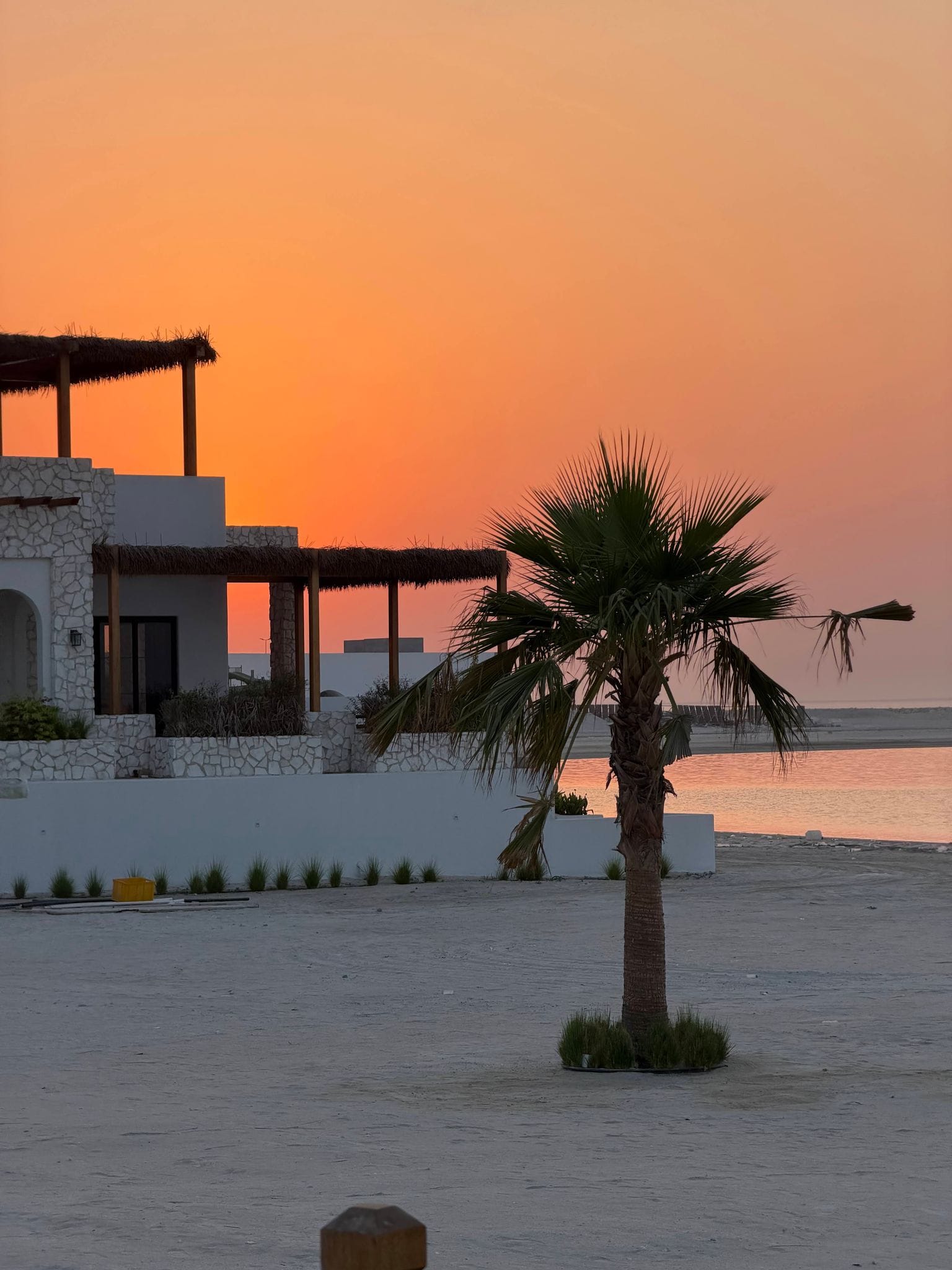
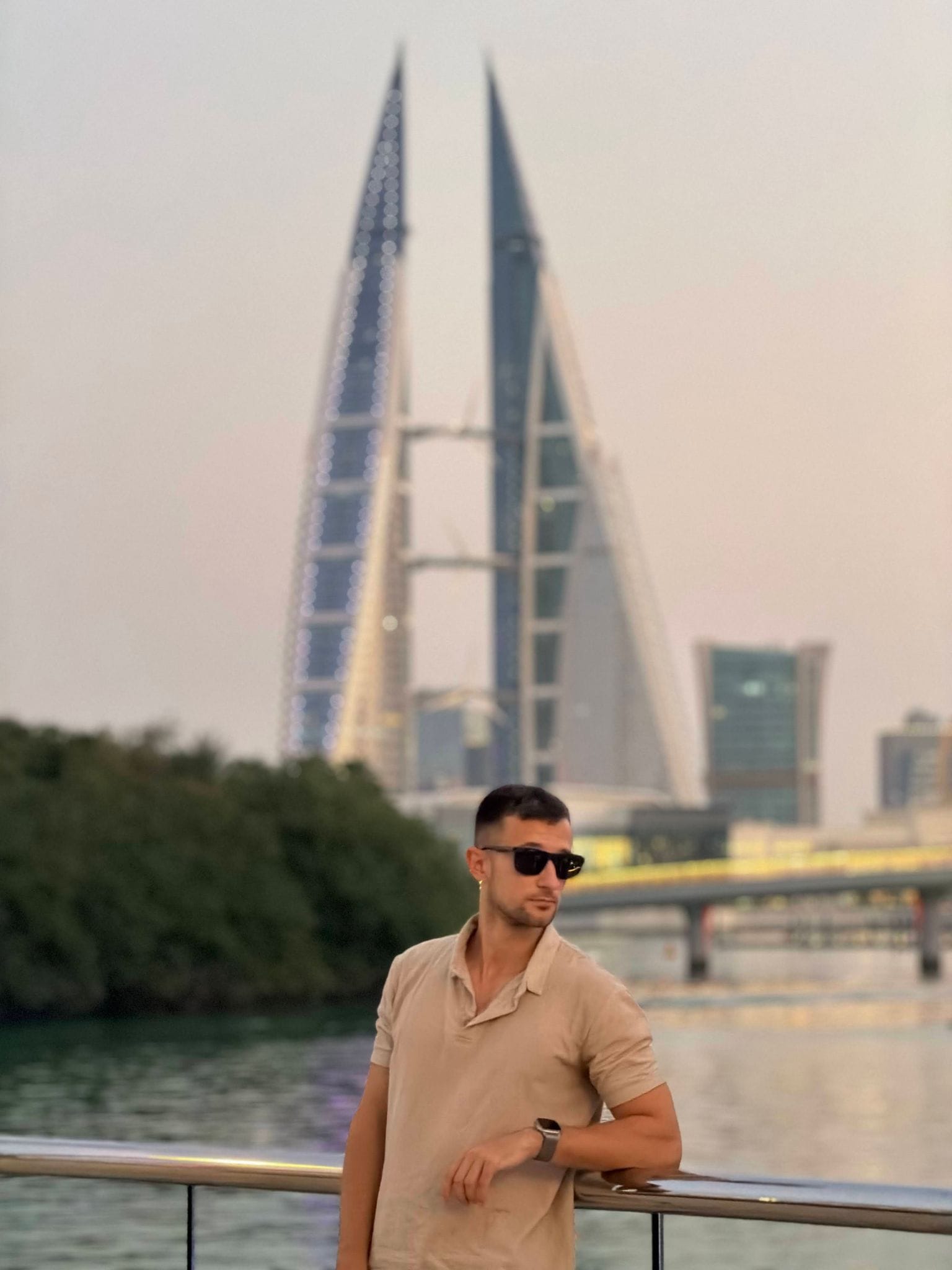
So I moved a little further, to Bahrain Bay itself, a 1.35 km² waterfront district built on reclaimed land. Finding parking took a detour: I followed the navigation and ended up at the entrance of the Four Seasons — the 48-floor hotel tower with a hole through the top, on its own island — where the staff pointed me to the public car park. Then the sky started changing colors, and I took a lot of photos.
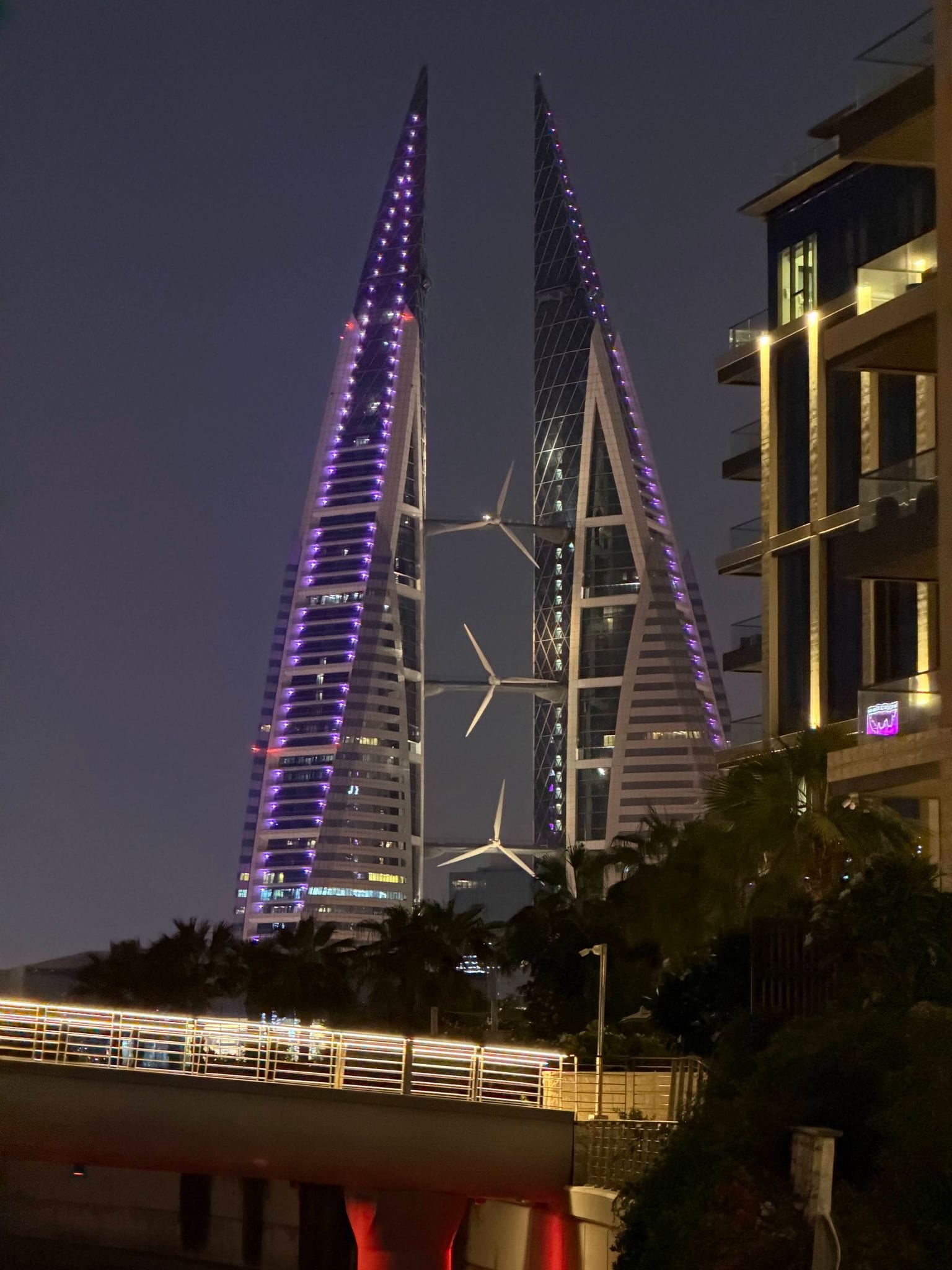
The sail-shaped twin towers behind me are the Bahrain World Trade Center, the ones with three wind turbines on bridges between them. After dark many of the towers lit up purple. Someone in Kuwait had already told me why: October is Breast Cancer Awareness Month, and Bahrain's Ministry of Health marks it officially. On the Bahrain Financial Harbour side, one tower showed a giant pink ribbon.
I was told that one woman in six gets breast cancer. The real figure is lower, but the numbers are still serious: according to the WHO's cancer agency, breast cancer is the most common cancer among women in Bahrain, at 42% of all new cancer cases in women — almost every second one. About 1 in 14 women there gets it before 75.
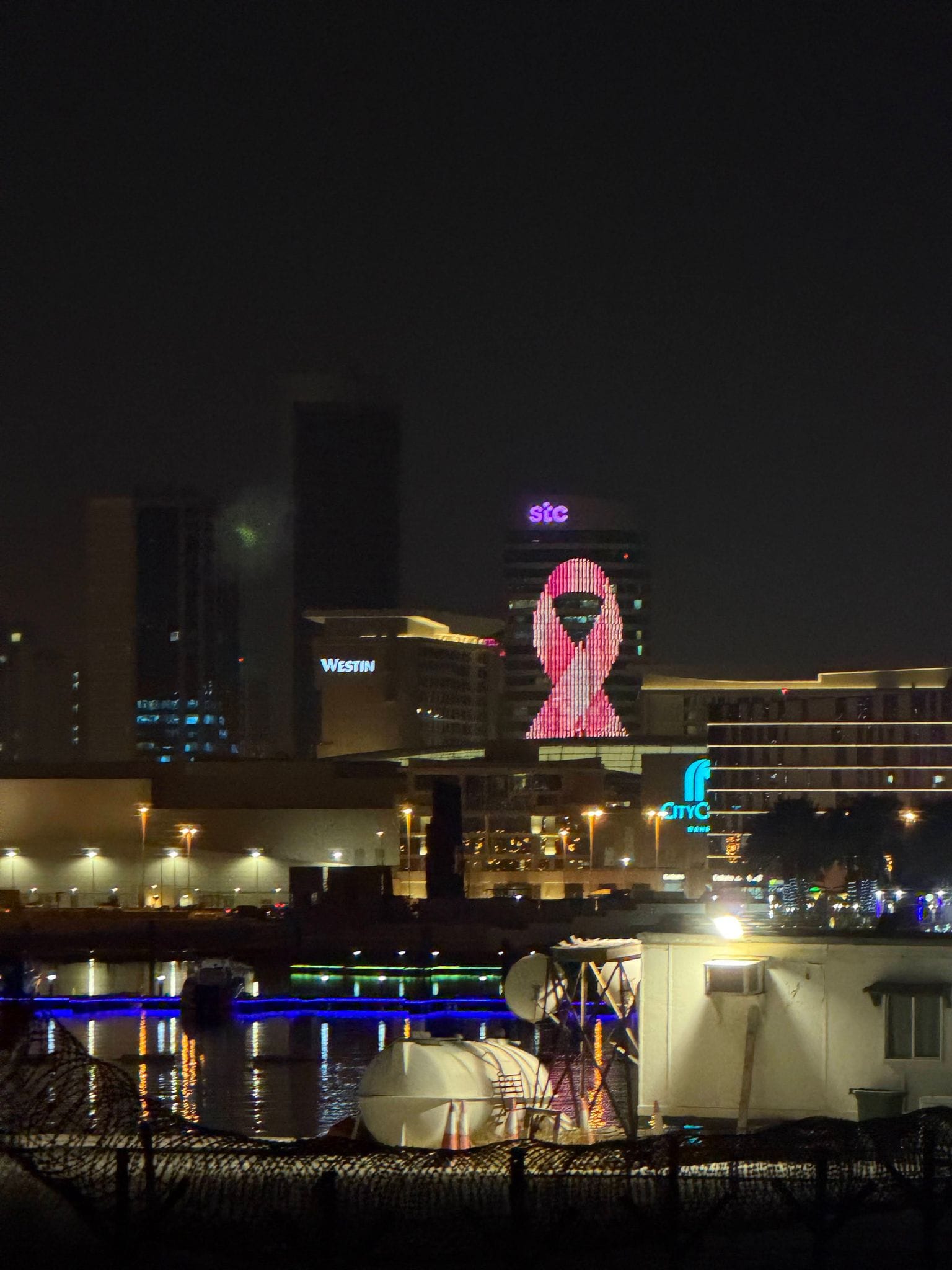
What struck me more than the lights was how empty everything was. Bahrain Bay had just a couple of tourists. The Financial Harbour, with its twin 53-floor Harbour Towers, had almost nobody at all. I'm not sure why. Maybe it was the hour, maybe the heat. Maybe it was the war: Bahrain hosts the US Navy's Fifth Fleet and was hit by Iranian strikes earlier in 2026. Either way, I hardly saw anyone in the streets those two days.
Navratri in the souq
My hotel, the Oriental Palace, was in the old center, a short walk from the souq and Bab Al Bahrain — the 1949 gate that once stood on the shoreline, before the land in front of it was reclaimed from the sea.
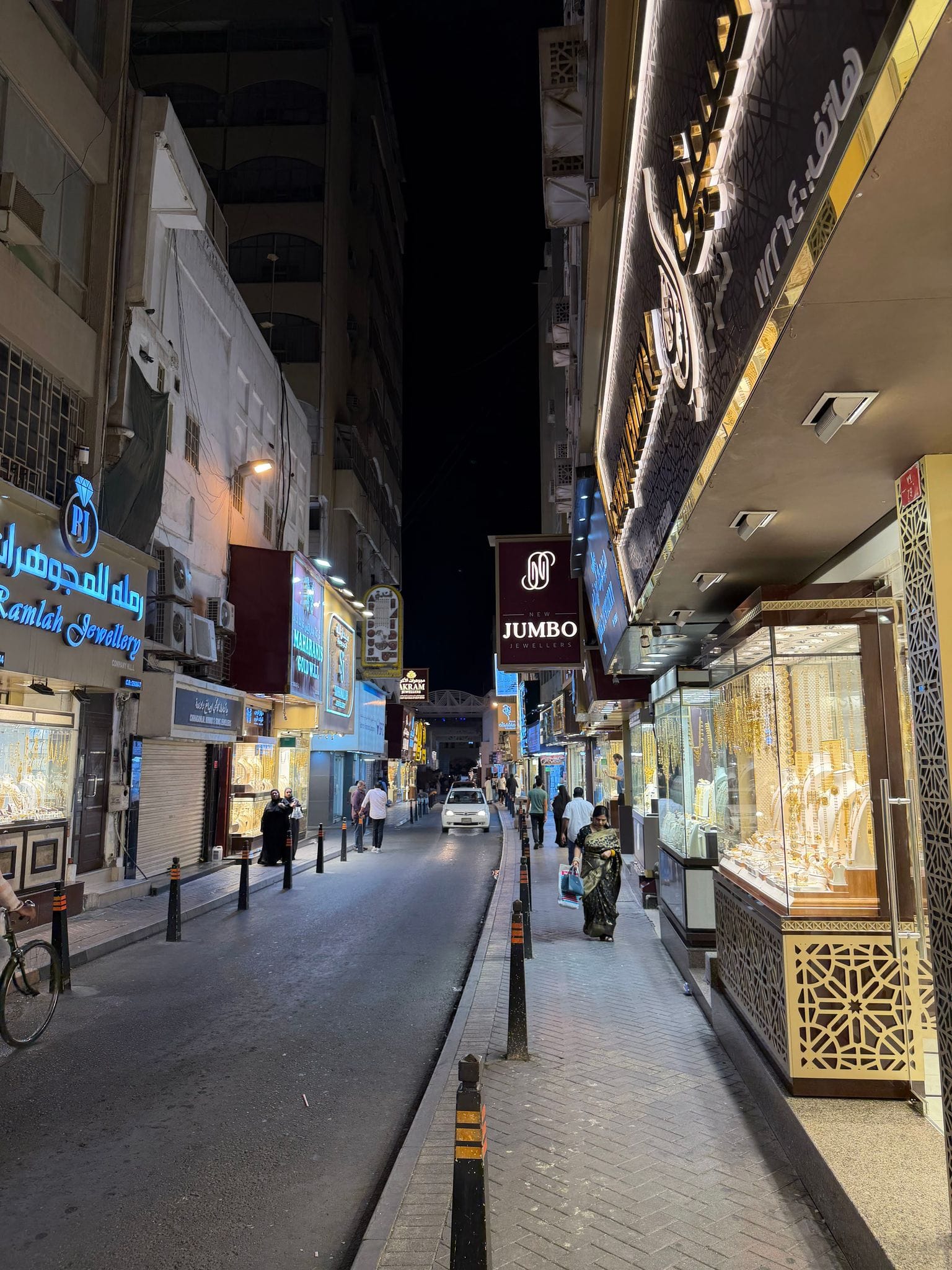
I went into a small shop to buy souvenirs, and the owner told me there was an Indian festival going on right then, in the courtyards behind the shops. "Once a year," he said. The courtyards are tight, and the celebration filled them: lights strung overhead, whole families on carpets. I walked in, filmed a bit, and people were happy to see me — "come in, this happens only once a year."
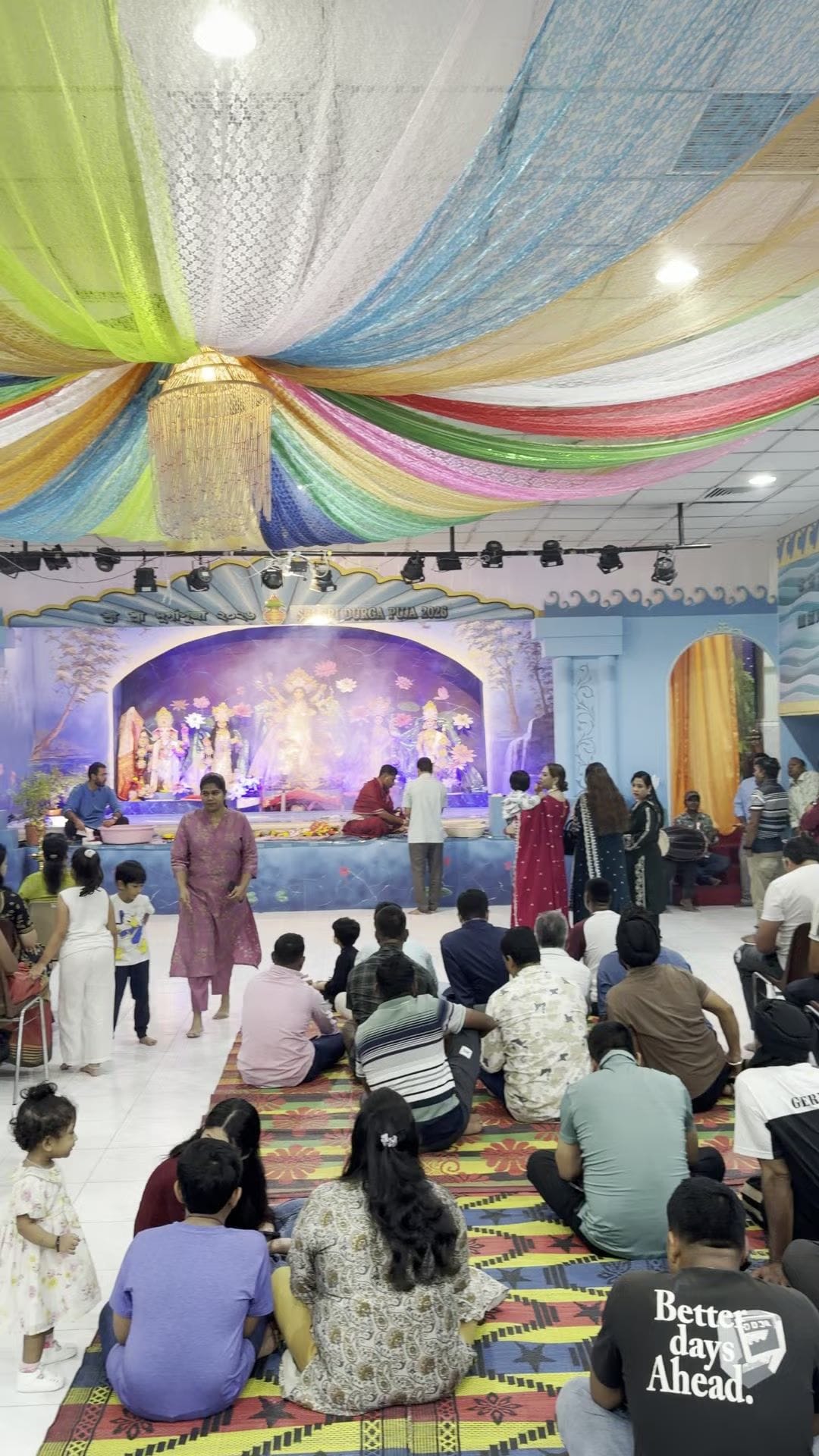
It was Navratri, "nine nights", the Hindu festival honoring the goddess Durga in her nine forms. In 2026 it ran from October 11 to 19, so I arrived on the seventh night. It ends with Dussehra, the day that celebrates good defeating evil, and in Gujarati tradition the nights are for garba and dandiya, circle dances with decorated sticks.
The festival centers on the Shrinathji temple, a Krishna temple hidden inside the souq. It's about 200 years old, founded by Hindu merchants from Sindh. The poster I took a selfie with marked 200 years of the Bhatia community, the merchant community that built it. Today about 340,000 Indians live in Bahrain — roughly a quarter of the population and the largest foreign community in the country.
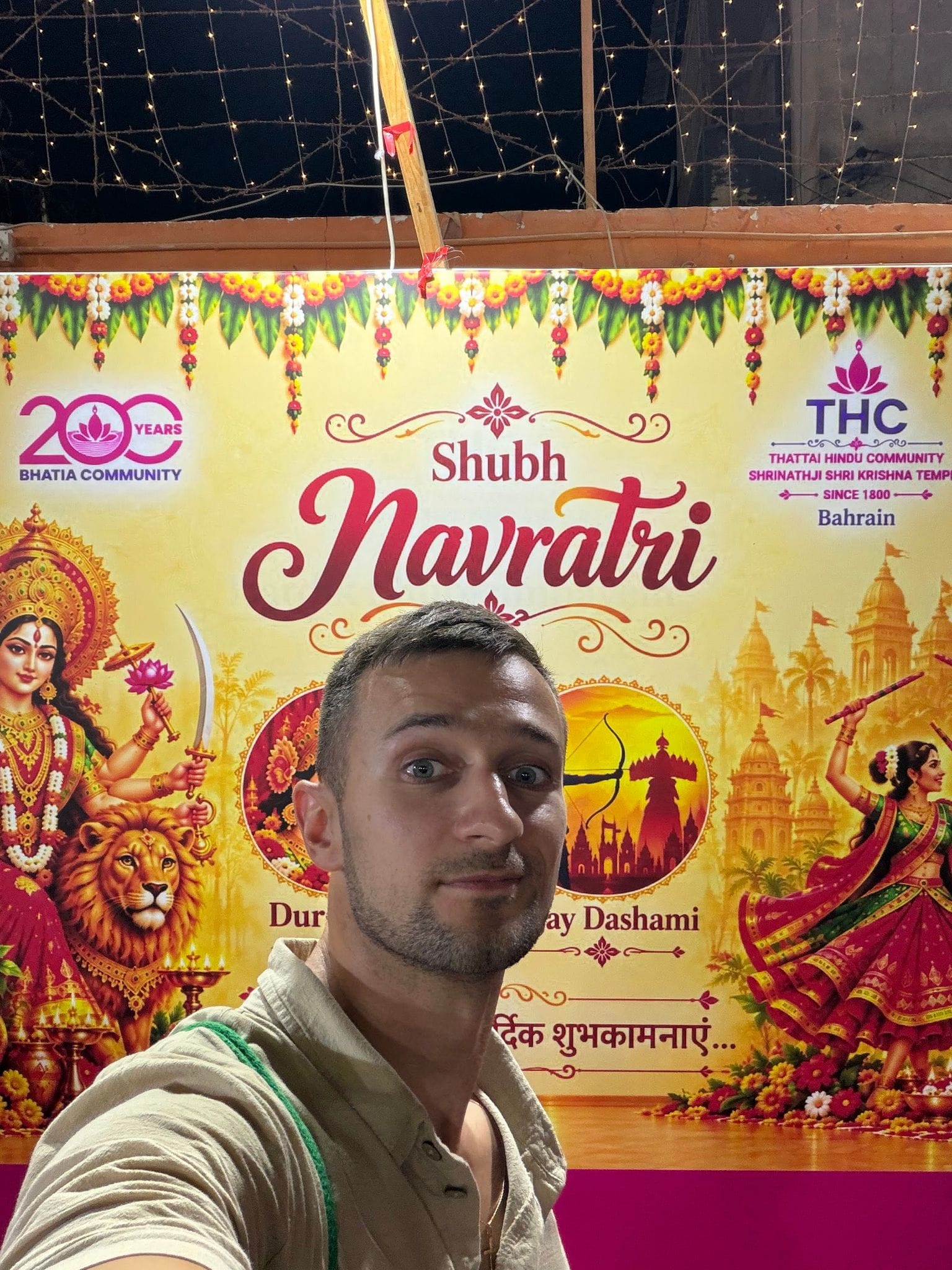
Then I walked around the souq a bit longer and bought a few souvenir maps and other small things before bed.
Bahrain Fort: 4,000 years under one mound
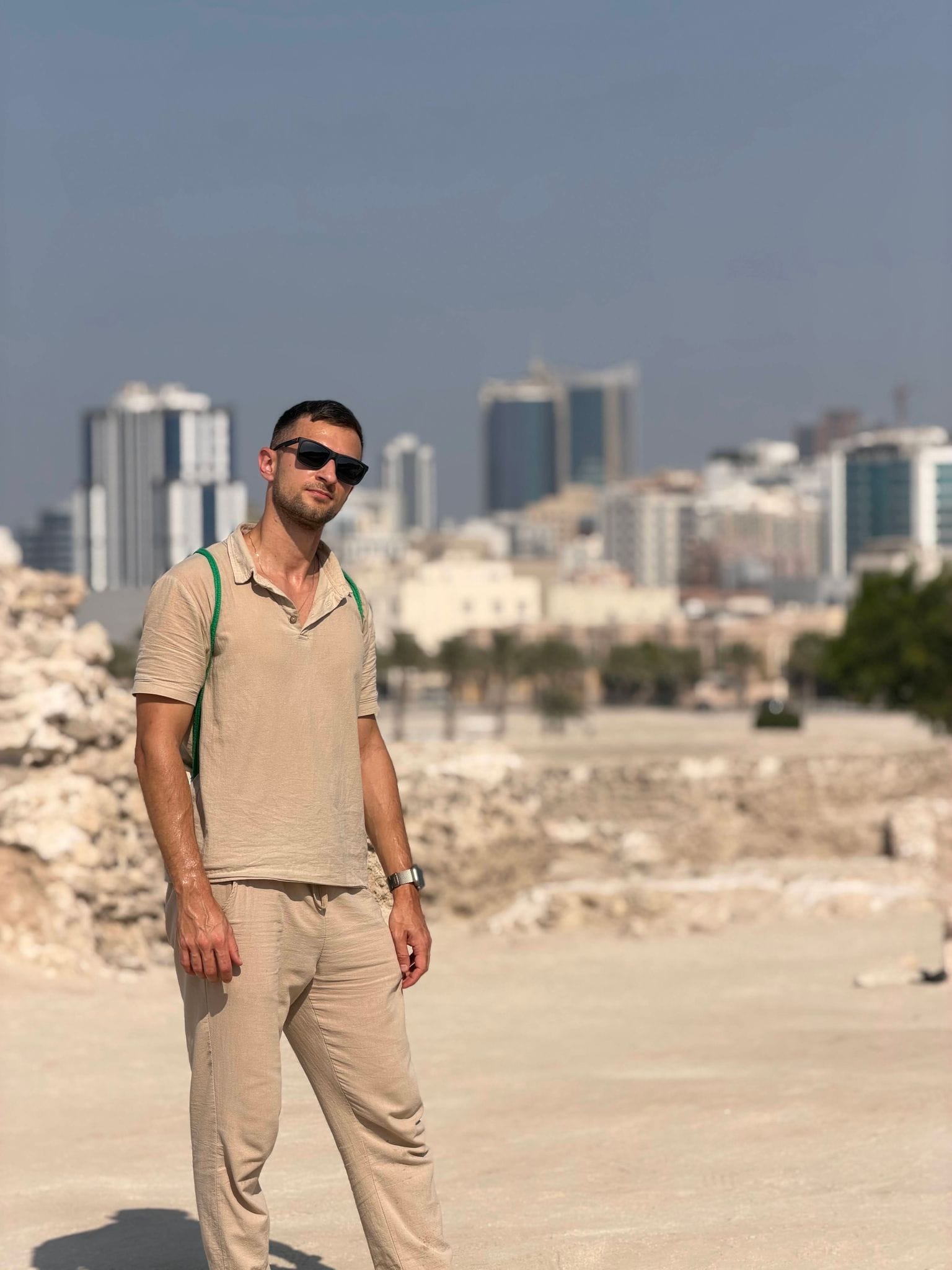
The next morning I drove to Qal'at al-Bahrain, the Bahrain Fort, on the north coast. It was 35°C, and I sweated through everything.
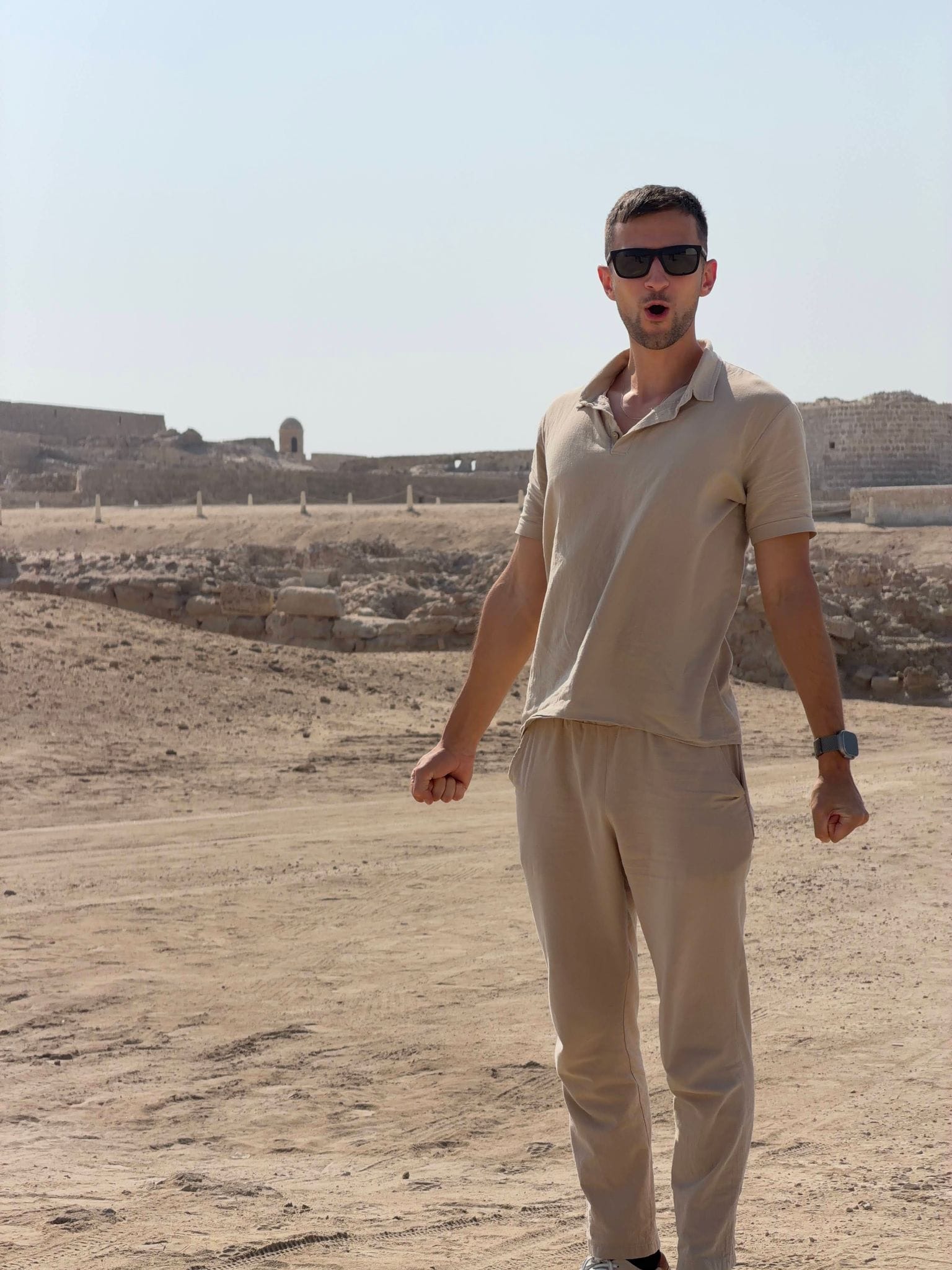
The fort itself is "only" Portuguese, from the 16th century. What's underneath is the point. The site is a tell, a 12 m mound made of city built on top of city, occupied from about 2300 BC until the 16th century AD. It was the capital of Dilmun, a civilization that traded copper and pearls between Mesopotamia and the Indus Valley and peaked around 2000 BC. Sumerian myths describe Dilmun as a kind of paradise. Only about a quarter of the mound has been excavated. UNESCO listed it as a World Heritage Site in 2005.
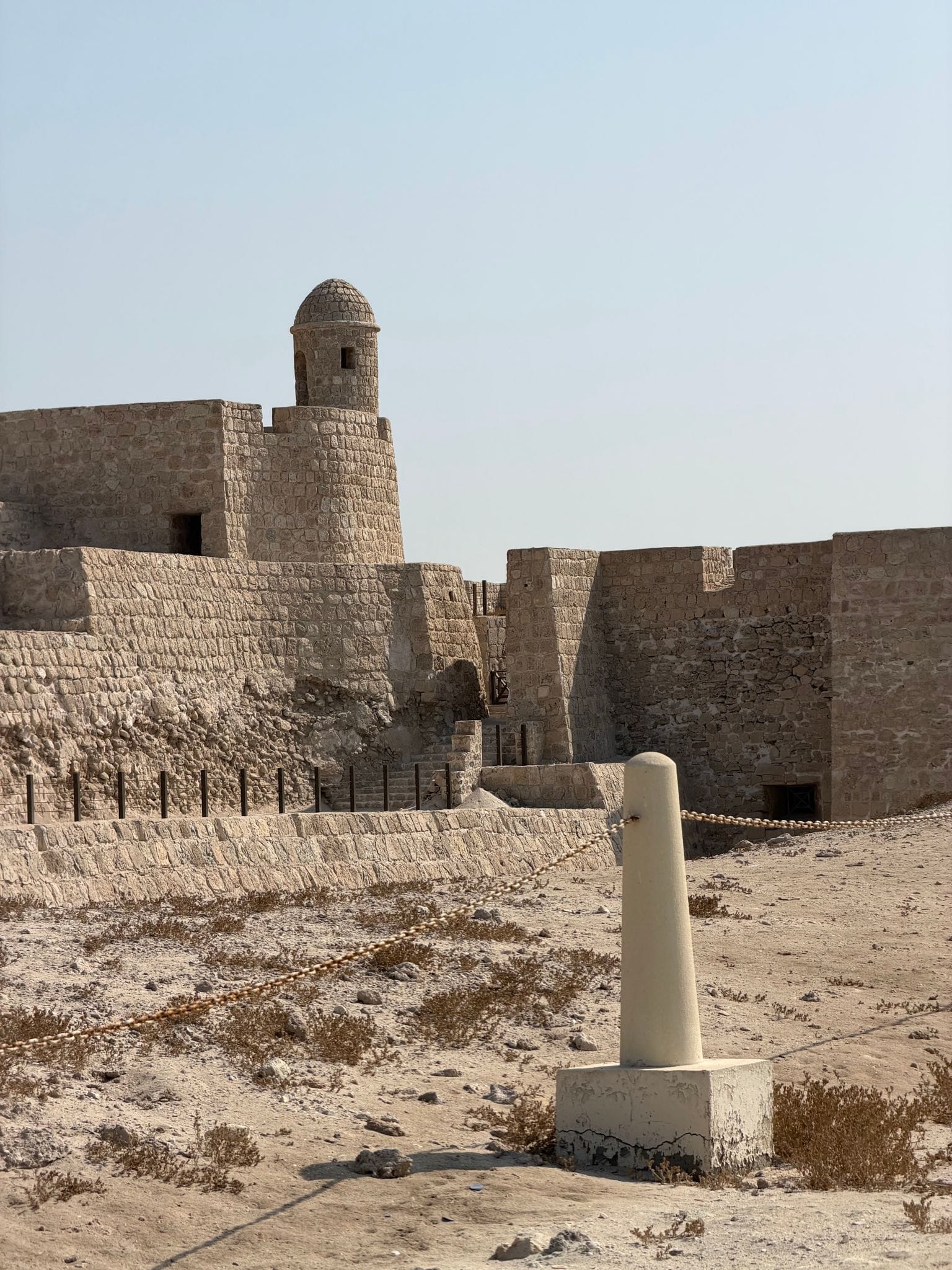
That's the part I couldn't get my head around. A thousand years ago we had Kyivan Rus. Four thousand years ago something was already happening here, with ports, temples and trade, while at home, as it felt to me standing there, nothing was. That's not entirely fair to Ukraine: the Trypillia culture built huge settlements on our land even earlier. But nothing of it stands like this, a fort on top of four thousand years of streets. Wow.
Al-Fateh Grand Mosque and an hour with a guide
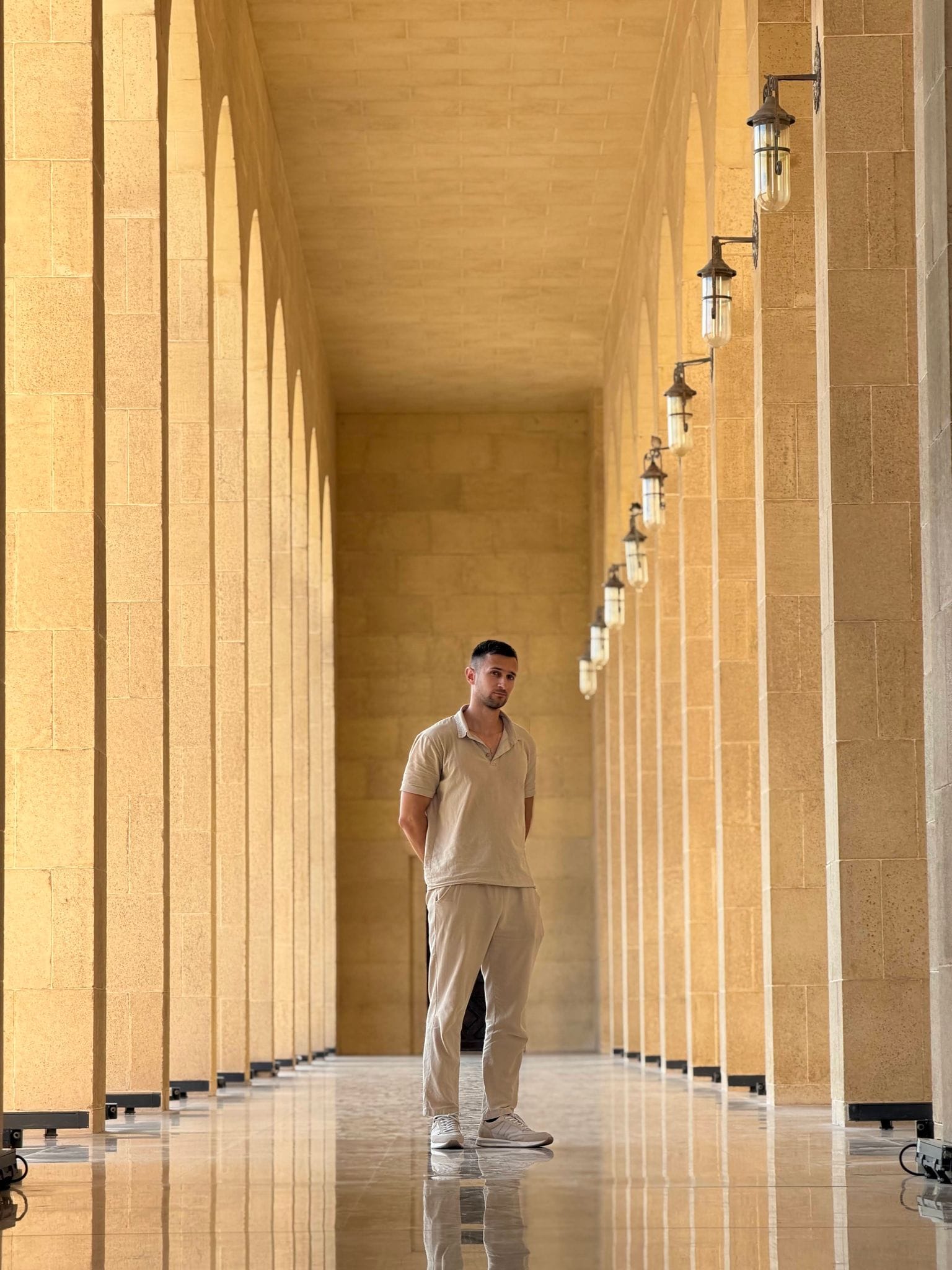
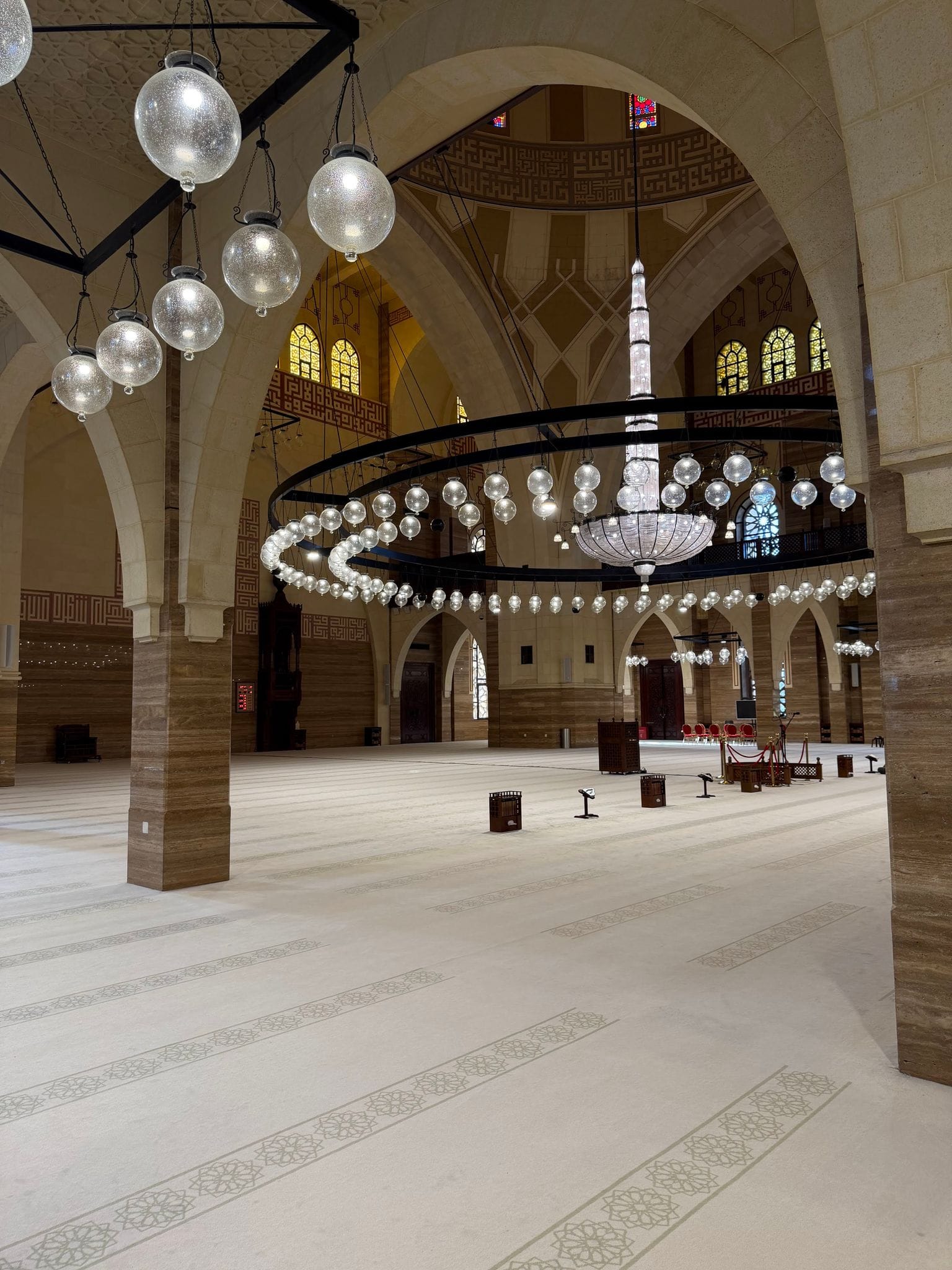
From the fort I drove to the Al-Fateh Grand Mosque, Bahrain's largest, opened in 1988 for about 7,000 worshippers. Its dome is made of fiberglass. When I arrived it was prayer time, and visitors weren't allowed in.
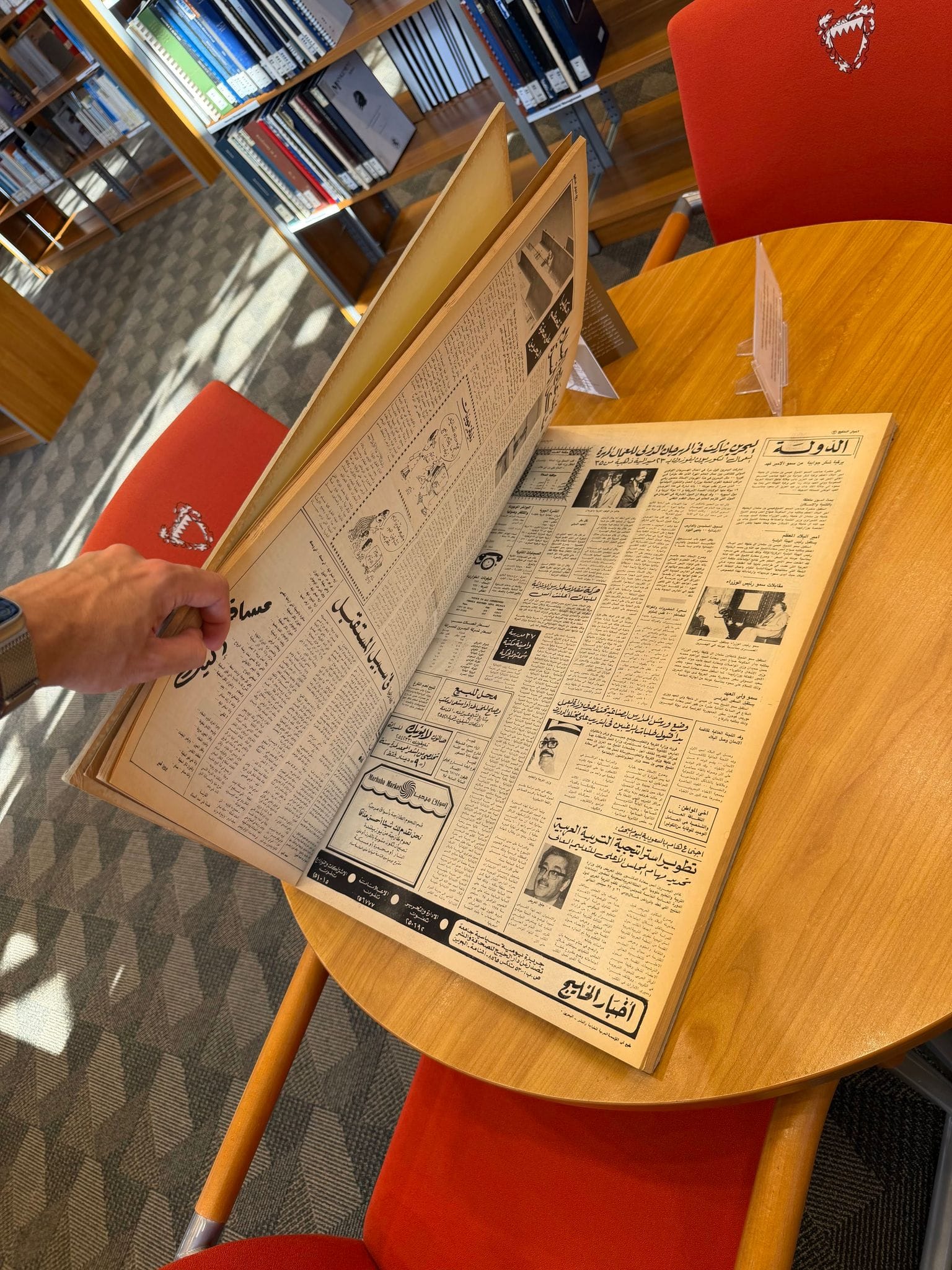
So I waited next door at the Isa Cultural Centre, home of the National Library of Bahrain. The best part was the press archive: enormous bound volumes of old Bahraini newspapers you can just open on a table and leaf through.
After the prayer I came back and found out the mosque can only be visited with a guide. Mine turned out to be a Russian-speaking woman, and we ended up standing and talking for about an hour — about Islam and how everything is organized. I was the only person on the tour. Inside there's a board of QR codes, each linking to a translation of the Quran into a different language. Ukrainian is there too.
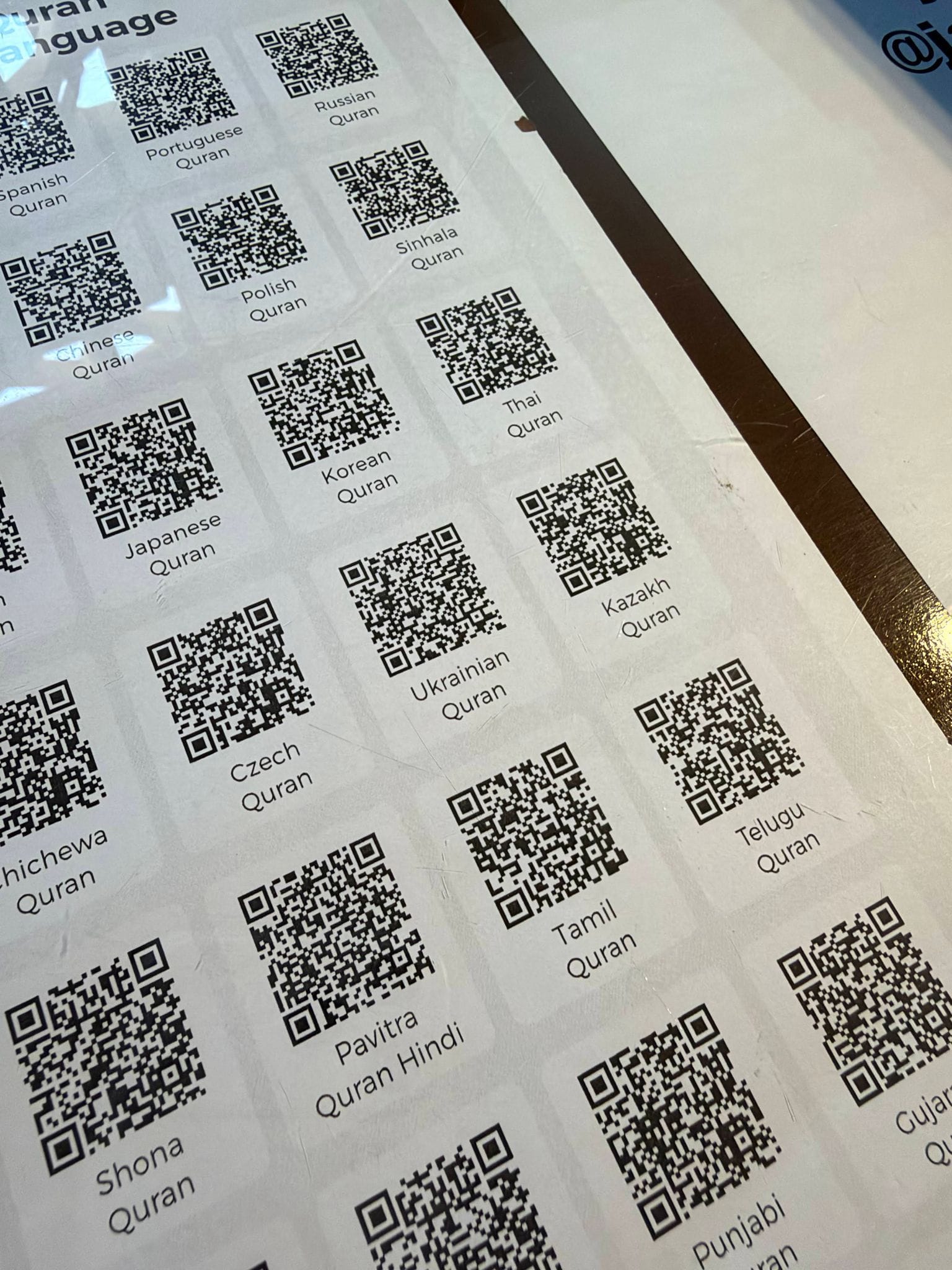
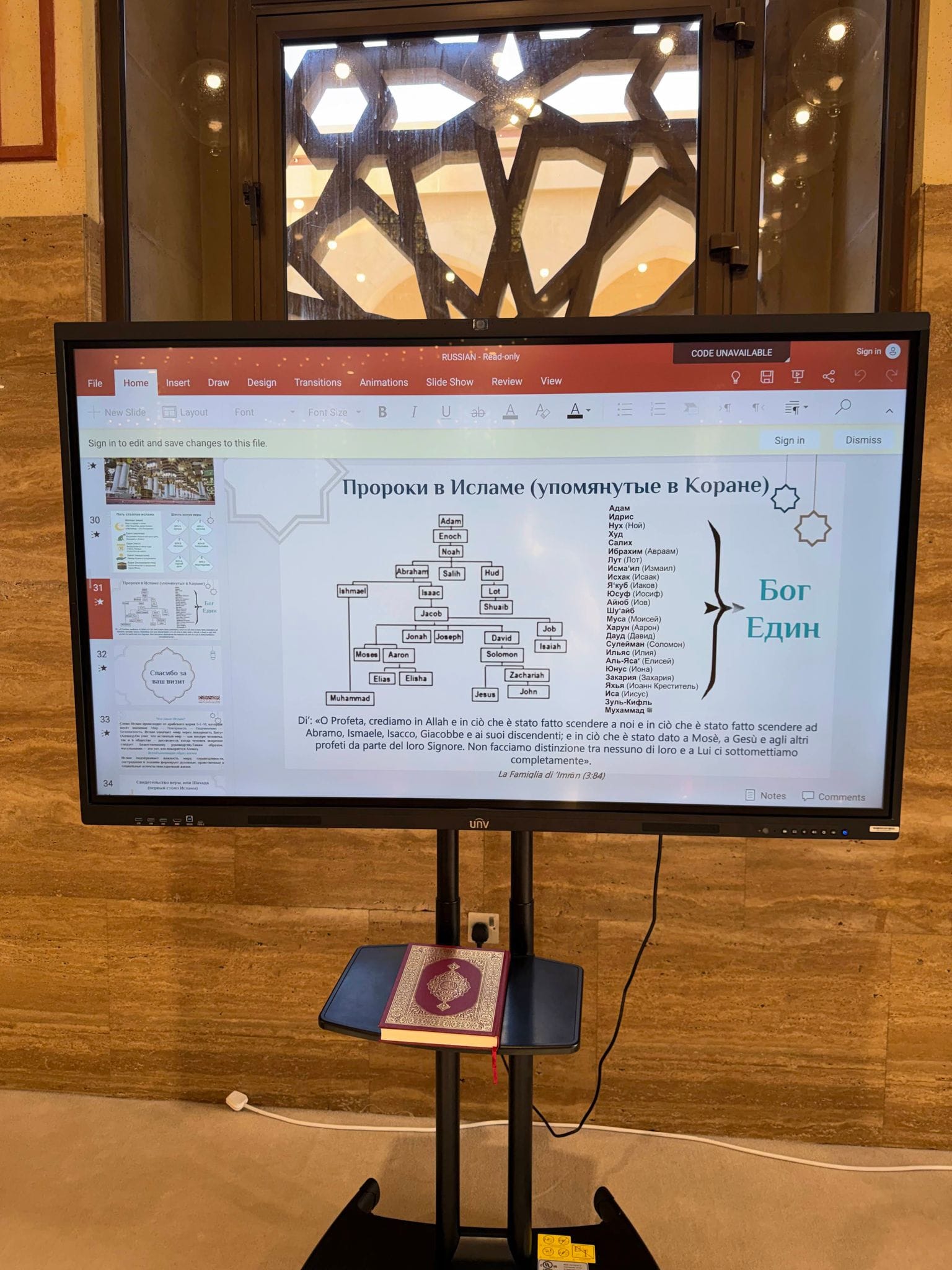
She walked me through slides on a screen, one of them a family tree of the prophets mentioned in the Quran. Many names are familiar from the Bible: Adam, Noah, Abraham, Moses, David, Jesus. Muhammad sits at the end of Ishmael's line. As she explained it, he was the last prophet, the Quran was revealed to him, and there will be no more prophets after him. In their teaching, the world is now moving toward its end. I'm not going to retell everything she said, but listening to it was fascinating, if only as history.
From the mosque I drove back to the airport, returned the car and spent the rest of the evening in The Pearl Lounge — by my own ranking, officially number one by size. It took me 3–5 minutes just to walk around it, and there's a games room with a pool table and table football. More about it, and the seven other lounges, in the Road to 90 overview.
Practical Notes
- eVisa: Bahrain's single-entry eVisa cost BD 10 (about $27) for my Ukrainian passport and was approved within a day. Kuwait Airways checked the printout before issuing the boarding pass.
- Car vs taxi: a taxi from the airport into Manama was about $15, a walk-in car at the Budget desk about $30 a day. If you stay a full day, the car wins.
- Al-Fateh Grand Mosque: free guided tours for non-Muslims, roughly 9:00–16:00 Saturday to Thursday, none on Fridays and none during prayers. If you hit a prayer, the National Library at the Isa Cultural Centre next door is a good place to wait.
- Heat: it was still 35°C in mid-October, and Bahrain Fort has little shade. Go early or late, and bring water.
- Drones: owning or flying one in Bahrain needs a licence plus Defence and Interior Ministry approvals, and travel guides report drones being confiscated at customs. For a tourist, leave it at home.
- Lounge: The Pearl Lounge at Bahrain airport is free with DragonPass. Come early.
- Onward: I flew Air Arabia to Yerevan via Sharjah, with a night at the hotel opposite Sharjah airport instead of a terminal bench.
I flew out at 20:10 with one country left to 90. One number stayed with me: by the time the Portuguese built their fort, the mound under it was already older than Kyiv is today.
Related posts
- Road to 90: Azerbaijan, Kuwait, Bahrain and Armenia in 8 DaysOct 14, 2026
- Kuwait City in Two Days: a Street Interview and My First Arabic CoffeeOct 16, 2026Kuwait City, Kuwait
- Climbing Mt. Fuji: Subashiri Up, Yoshida Down (2026 Guide)Aug 17, 2026Mount Fuji, Japan
- Kyoto and Tokyo in a Week — Japan, Country #85Aug 14, 2026Kyoto & Tokyo, Japan