
Kyoto and Tokyo in a Week — Japan, Country #85
Tokyo is now my favorite city in the world, and I only had two nights there. Japan became my country #85 in August 2026, one week of my four-week Asia trip: three nights in Kyoto, a night in a hut on Mt. Fuji, and two nights in Tokyo. This post covers Kyoto's five fires on August 16, a hotel public bath I didn't expect to love, and Shibuya at night.
Japan is home to almost 123 million people, and Greater Tokyo alone holds about 37 million of them — the third-largest urban area on Earth. Fun fact: Japan officially counts 14,125 islands.
Kyoto first impressions: a city on a 1,200-year-old grid
We flew in from Seoul to Osaka's Kansai airport and went straight to Kyoto for three nights. On Instagram I called it "our first Japan waypoint" and a "lovely historic city".
Kyoto doesn't hit you with temples at first. It looks like a normal large city of 1.4 million people, with one odd detail: almost all the buildings are the same height. That's by design. Kyoto tightened its building height limits in 2007, and most of the center now tops out at 31 m.
The streets are the other thing. Stand on a long avenue when it's empty and you can see where it ends, kilometers away. Kyoto was founded in 794 as Heian-kyō, a grid modeled on the Chinese Tang capital Chang'an, and the center still follows it: wide, straight streets for cars, with neat, narrow lanes tucked between the blocks. Our hotel was near Gojō, which literally means "Fifth Street". The name comes from that numbered grid, although the street itself has moved — the original Gojō ran where Matsubara Street is today.
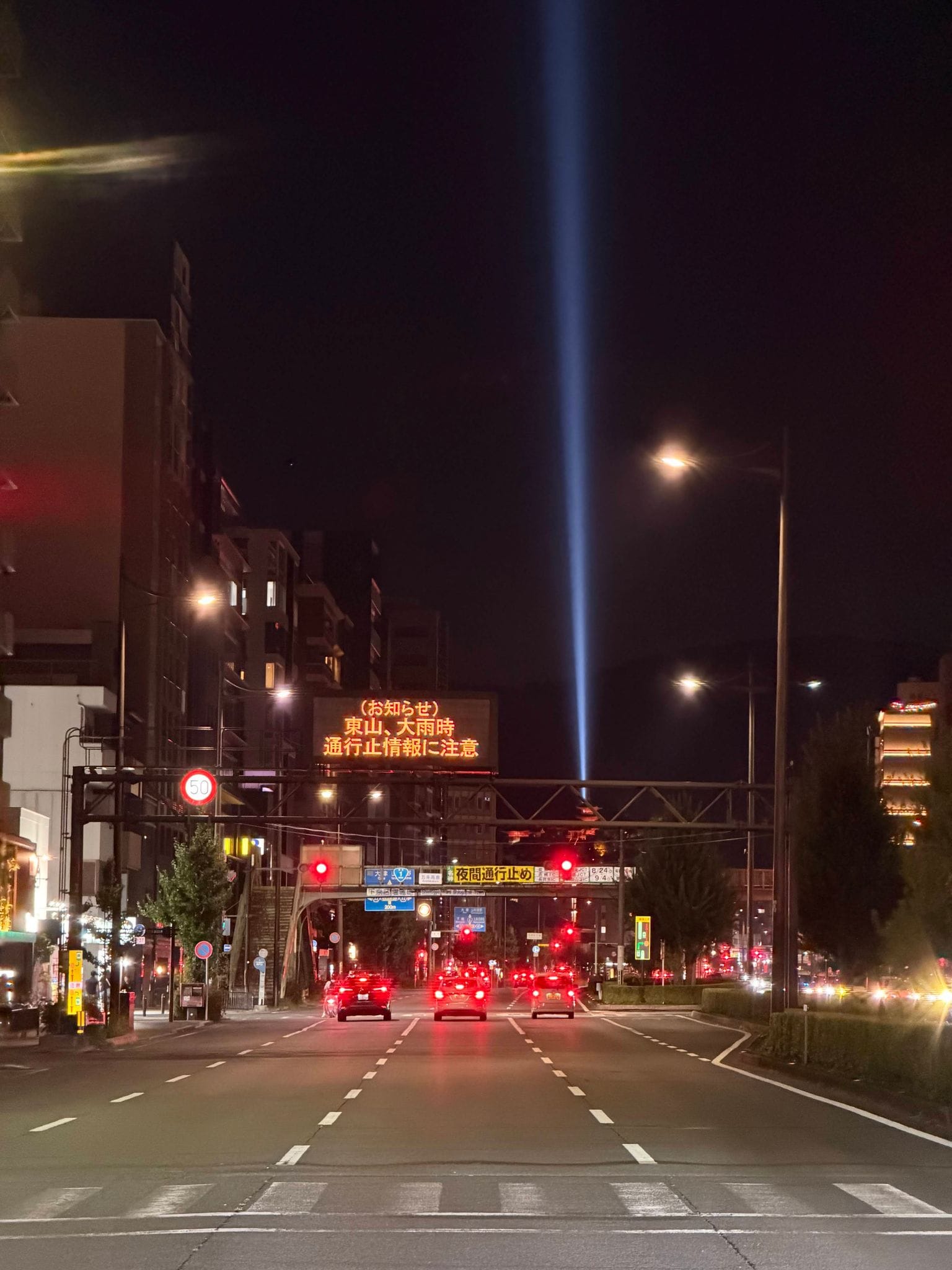
Then the cars. Many taxis look like they came straight out of the 90s, but they're new. The tall Toyota JPN Taxi, built since 2017, was designed partly to be as recognizable as a London black cab and has a sliding rear door. It replaced the boxy Crown Comfort, which Toyota made for over 22 years. Private cars are small. Japan is the home of Suzuki, and the Suzukis here are nothing like the European ones — many are kei cars, a class legally capped at 3.4 m long and 660 cc in exchange for tax breaks.
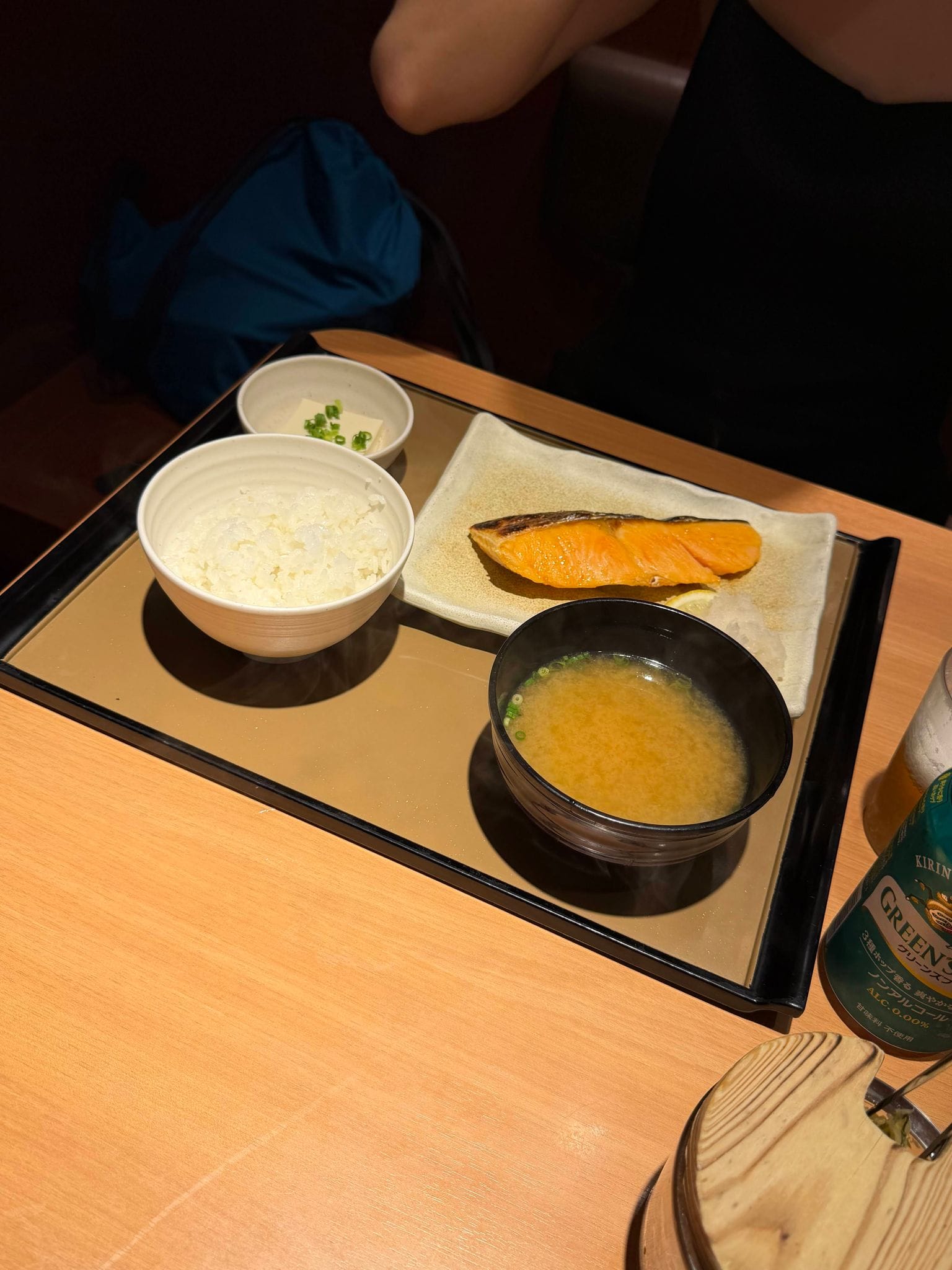
Food was a whole experience. Almost everything we ordered came as a set: a tray with 4–6 bowls — rice, soup and several small sides. That pattern is called ichijū sansai, "one soup, three dishes", the standard shape of a Japanese meal. I suspected there was a correct order, and there sort of is: you alternate bites of rice and dishes instead of finishing one bowl at a time. I'm pretty sure I did it wrong :)
Sagano Romantic Train and the Arashiyama bamboo grove
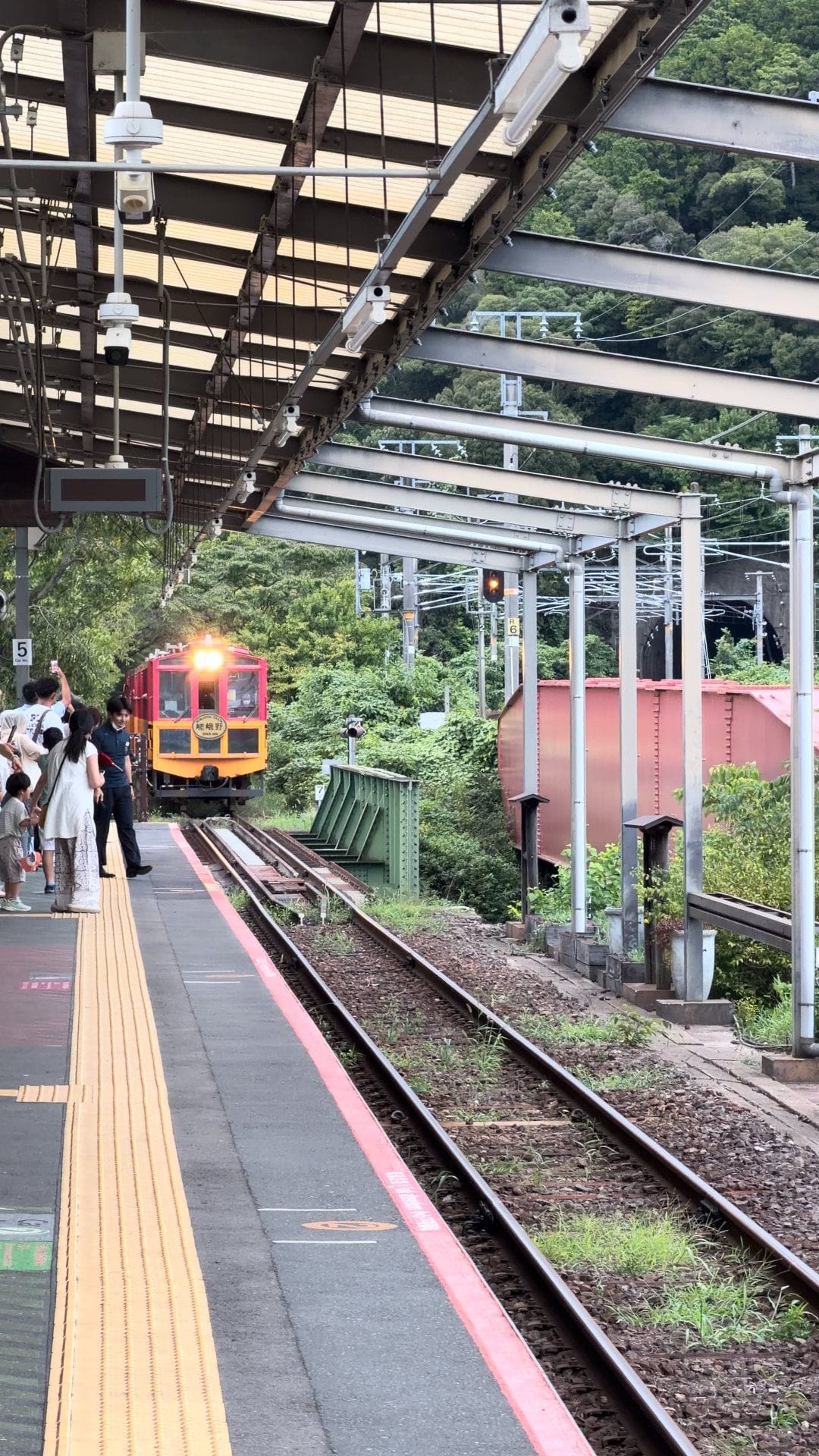
August 16 was our big Kyoto day. We started with the Sagano Romantic Train, an old-style sightseeing train that runs 7.3 km along the Hozu River gorge in about 25 minutes. We rode it from Kameoka to Saga in Arashiyama — not crowded at all, which I hadn't expected in mid-August.
Stepping off, we walked straight into a crowd of people dressed almost identically — office workers, I'm guessing, though I never found out for sure.
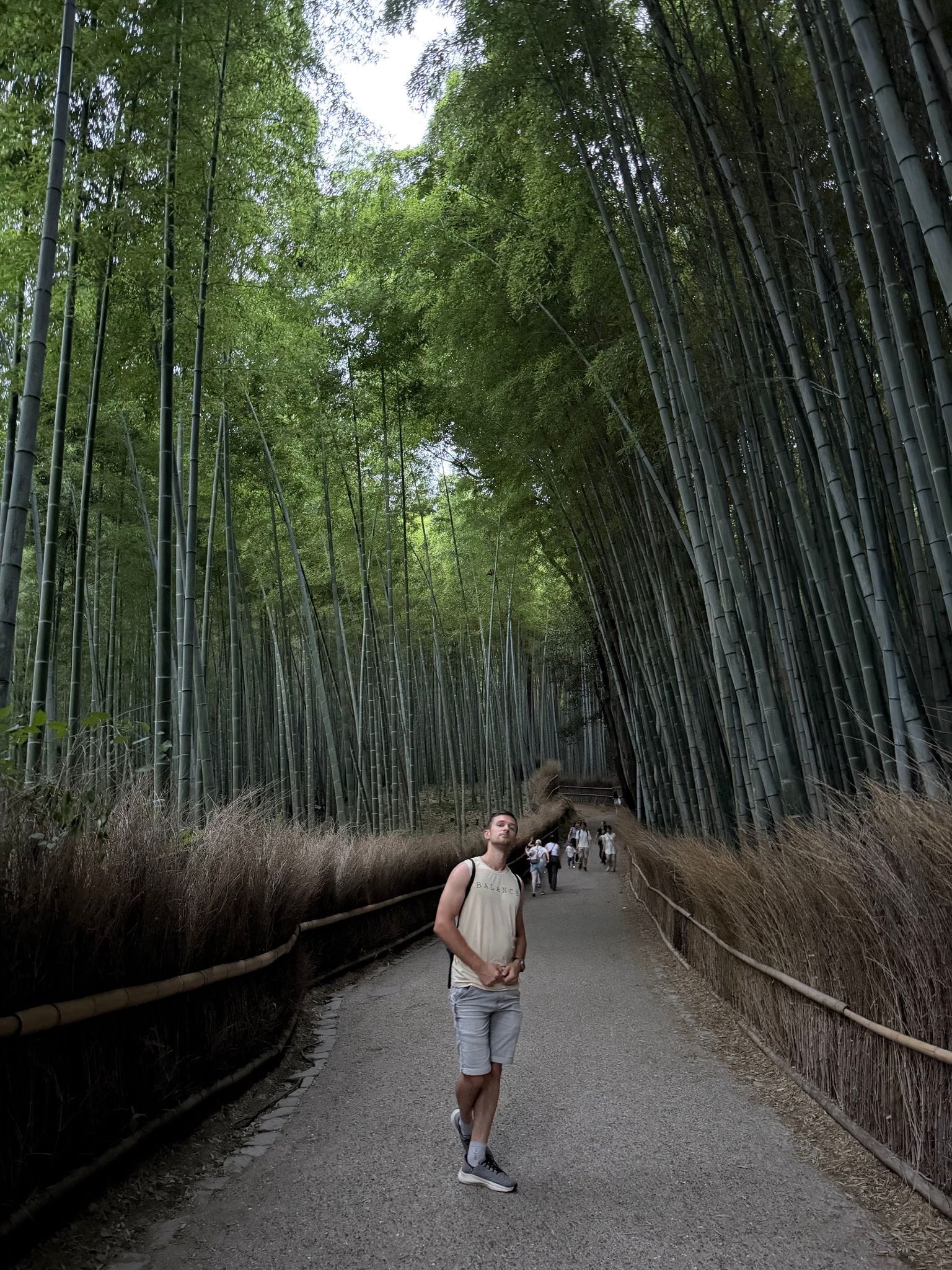
From there it's a short walk to the Arashiyama bamboo grove — the one from every Kyoto postcard. We went that same evening, a few hours before the fires, and it lived up to the postcards: gorgeous, and quiet enough for an unhurried walk and photos.
Gozan no Okuribi: Kyoto's five fires on August 16
This is why we stayed in the city that evening. Gozan no Okuribi closes Obon: from August 13 to 16, ancestors' spirits are believed to come home to their families. On the night of the 16th, five huge bonfires on the mountains around Kyoto send them back.
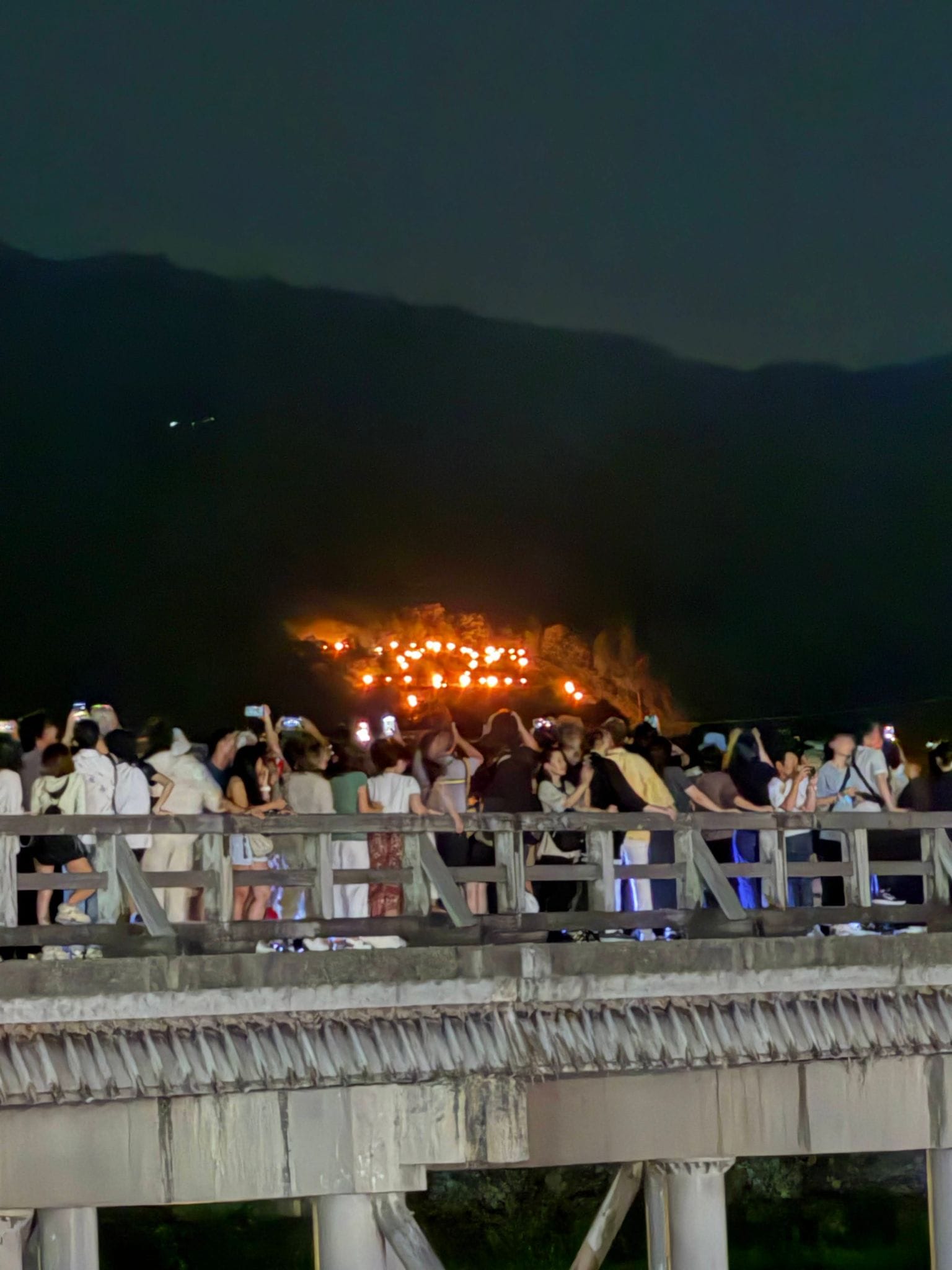
They're lit one after another. According to Kyoto's official guide, the 大 ("great") character on Daimonji goes first at 8:00 pm, then 妙法 (Myō-Hō) at 8:05, the boat shape (Funagata) at 8:10, a second 大 (Hidari Daimonji) at 8:15, and the torii gate (Toriigata) at 8:20. Each burns for about half an hour.
We watched from a bridge, and deliberately waited for it — one of the most unusual evenings of the whole trip. From there we could make out three of the five fires: one far in the distance, two much closer. Characters and shapes we couldn't read appeared on the dark hills, one by one. And the crowd: no music, no show — just a lot of people quietly watching. It makes sense once you know it's about those who passed. That same evening, lanterns drifted down the river below us too — the Arashiyama Toro Nagashi, part of the same Obon farewell.
We went to bed early. The next morning's Shinkansen left at 6:25.
From Kyoto to Mt. Fuji
We didn't go straight to Tokyo. We got off the Shinkansen early, climbed Mt. Fuji via the Subashiri trail, slept in a hut at about 3,000 m and came down the Yoshida trail the next day. It was the top highlight of the entire Asia trip, so it got its own post, with the 2026 fees, gear rental and buses: Climbing Mt. Fuji: Subashiri up, Yoshida down.
Tokyo: late arrival and booths in the metro
We reached Tokyo late on August 18, on a highway bus from Fujiyoshida that dropped us at a station on the edge of the city. From there it was straight onto the metro to our hotel, so on the first night we saw nothing else. That was already enough. Very new, very modern, and crowds of people — real crowds. And right there, soundproof business booths you can step into to take a call or work — I think they were near our hotel's own station, though I couldn't tell you which one. My honest reaction was "wow". Several companies run them: JR East's STATION WORK booths, for example, are rented in 15-minute blocks, and other operators put similar ones in Tokyo Metro stations.
Japanese public bath etiquette at a Tokyo hotel
We stayed at APA Hotel & Resort Ryogoku Eki-Mae Tower in Ryōgoku, Tokyo's sumo district, a short walk from the Kokugikan arena. The best thing about the hotel was in the basement: a large public bath (daiyokujō) with indoor pools and an open-air one, free for guests.
The rules are simple:
- No tattoos. Many Japanese baths still don't allow them, and this one didn't.
- Men and women bathe separately, fully naked, no swimwear.
- You wash first: sitting on a small stool at a shower station in front of a mirror, with shampoo and gels provided.
- Only then do you get into the hot water, and your small towel stays out of it.
The Japan National Tourism Organization's etiquette guide covers the rest.
What surprised me is how efficient it is. Five minutes at the seated shower and I'm done, then a soak, and a separate area with disposable razors, towels and everything else you'd need. I went twice and never used the shower in my room.
My fiancée didn't enjoy it as much. Being naked in front of strangers isn't for everyone, even when it's strictly split by gender — and that's fine. I'd go back tomorrow.
Shibuya Crossing and Hachikō
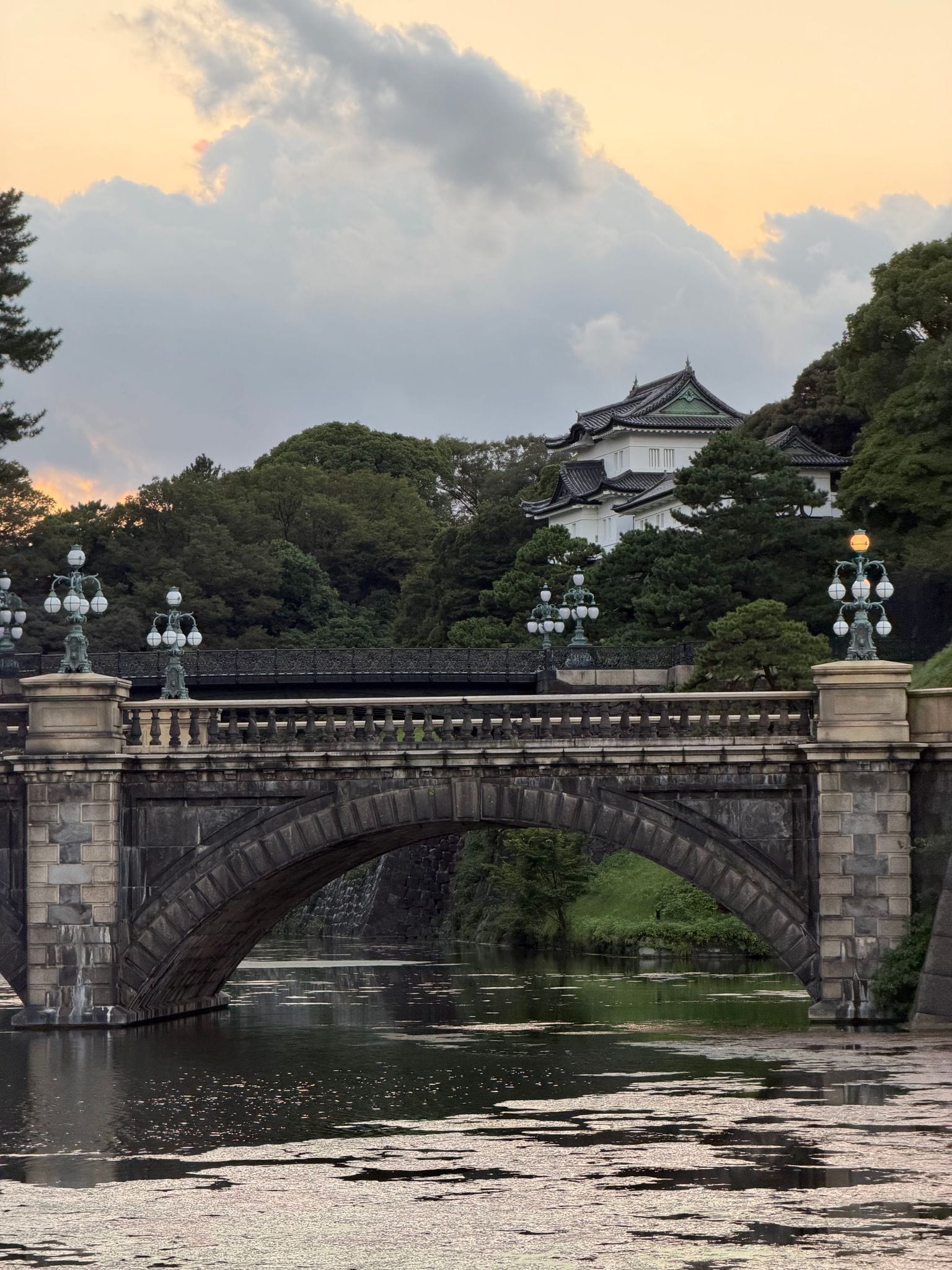
The next day, before Shibuya, we walked out to the Imperial Palace — or rather around it. We never went inside, whether it was the hour or the tickets I couldn't tell you, but the open paved plaza out front was beautiful anyway, especially with the light at sunset.
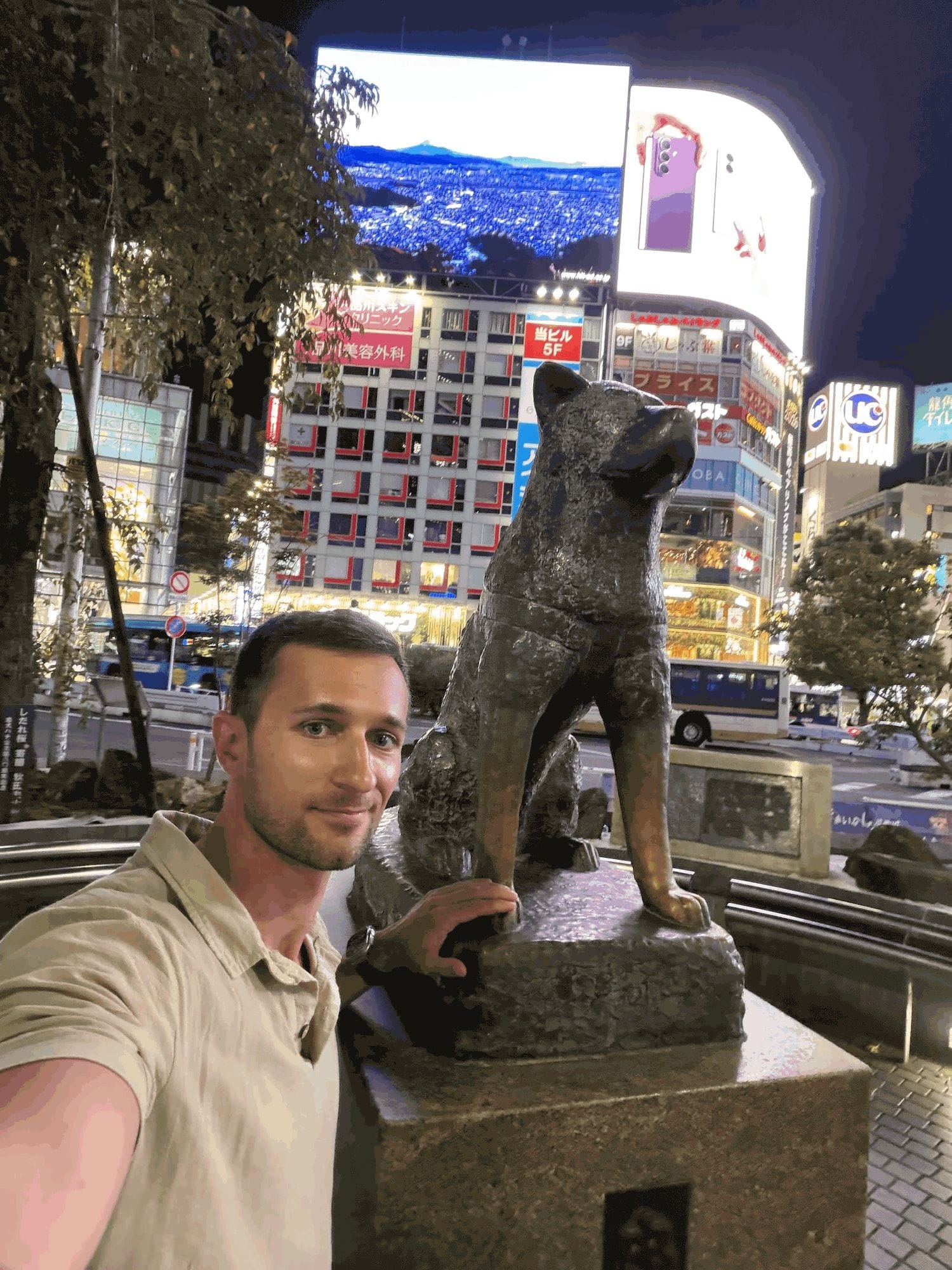
Then Shibuya, the place I wanted to see most. Shibuya Crossing stops all car traffic and lets everyone cross in every direction at once — up to 3,000 people per green light. Next to it stands Hachikō, the Akita dog who kept coming to Shibuya Station to wait for his owner for almost 10 years after the professor died in 1925. The current statue has been there since 1948. I took my picture with him, of course.
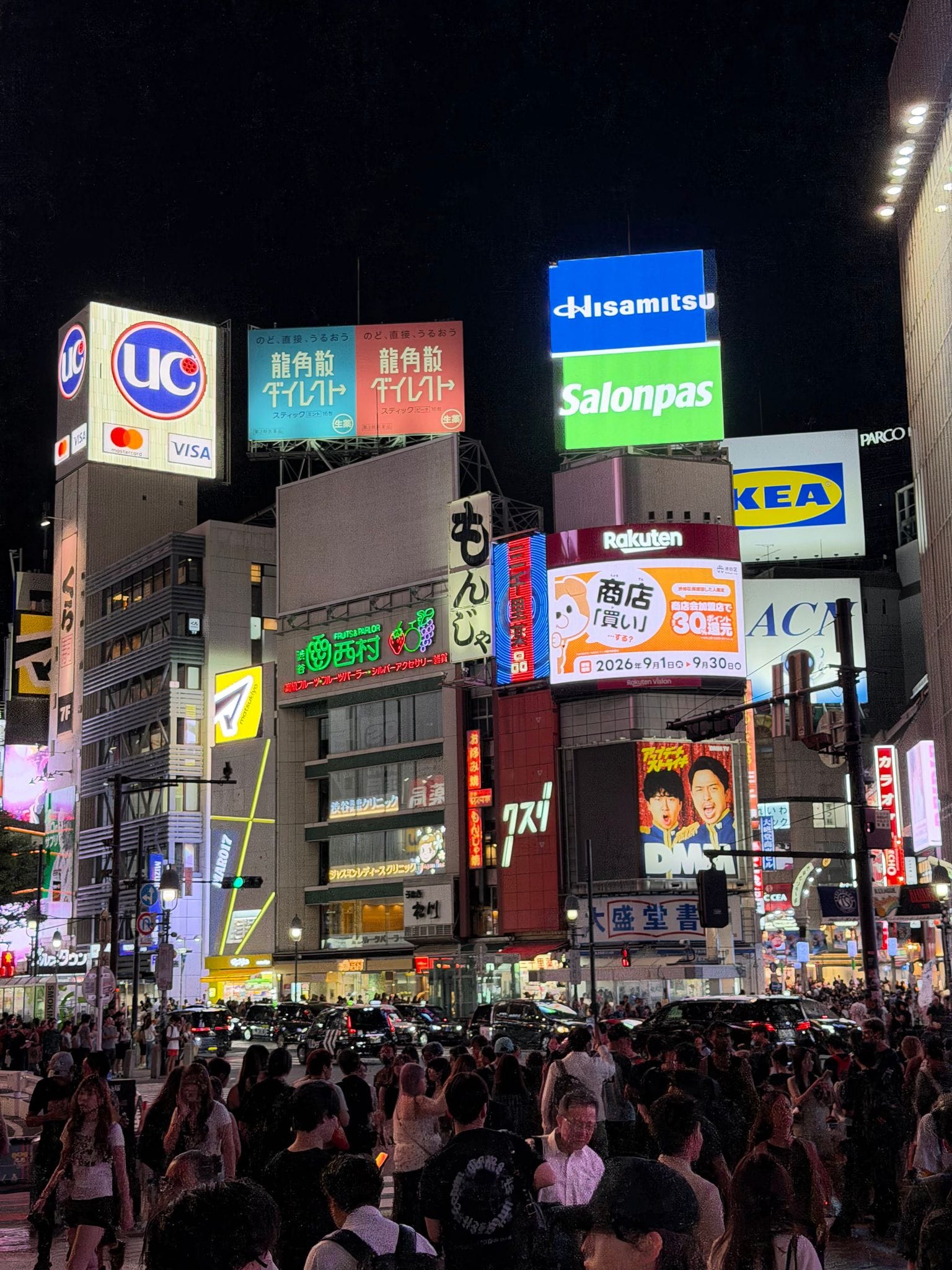
We spent 2–3 hours around the crossing: some shopping, photos, videos, and dinner at a basement place right on the corner of the crossing itself — loud, tasty, and I've long forgotten its name. Standing in the middle of that scramble, it felt like the center of the universe.
Practical Notes
- Kyoto and Tokyo itinerary: three nights in Kyoto covered the city plus a full day in Arashiyama. Two nights in Tokyo were not enough — with a week, I'd give Tokyo more.
- Gozan no Okuribi is on August 16 every year, with the fires lit between 8:00 and 8:20 pm. Kyoto's official guide asks people not to climb the hills that day, to stay off dark riverbanks and not to walk through the crowds staring at their phones.
- Sagano Romantic Train: online tickets go on sale at midnight Japan time, one month before the date. If reserved seats sell out, the station counters sell a limited number of standing tickets on the day.
- Public baths: wash sitting down before you get in, keep the towel out of the water, and check the tattoo policy before booking a hotel for its bath. APA's bath had razors and towels, so you can travel light.
- Drones: any drone of 100 g or more must be registered in Japan's DIPS 2.0 system before flying outdoors, carry its registration ID and broadcast Remote ID. Flying over densely inhabited districts (most of central Kyoto and Tokyo), near airports, at night or within 30 m of people and buildings needs prior permission — see MLIT's drone rules.
- Visa (Ukrainian passport): a sticker visa from the Japanese embassy in Warsaw, applied for in person before the trip.
- eSIM: a Superalink Japan eSIM cost me $7.82 for about 14 days and 10 GB (not sponsored).
- Prices: Japan didn't feel more expensive than Warsaw. Sometimes Warsaw is the pricier one.
The next morning we flew on to Siargao in the Philippines. On Instagram I wrote that I "will remember Tokyo as one of the warmest cities I've been to" and that "a few days in Tokyo were absolutely not enough". I still can't explain why it got to me more than any other city. Everyone was friendly, it's international, fast and somehow still slow and livable, but plenty of cities are some of that. I want to come back and spend more than two nights figuring it out.