
Beijing Layover: A Free Great Wall Tour From the Airport
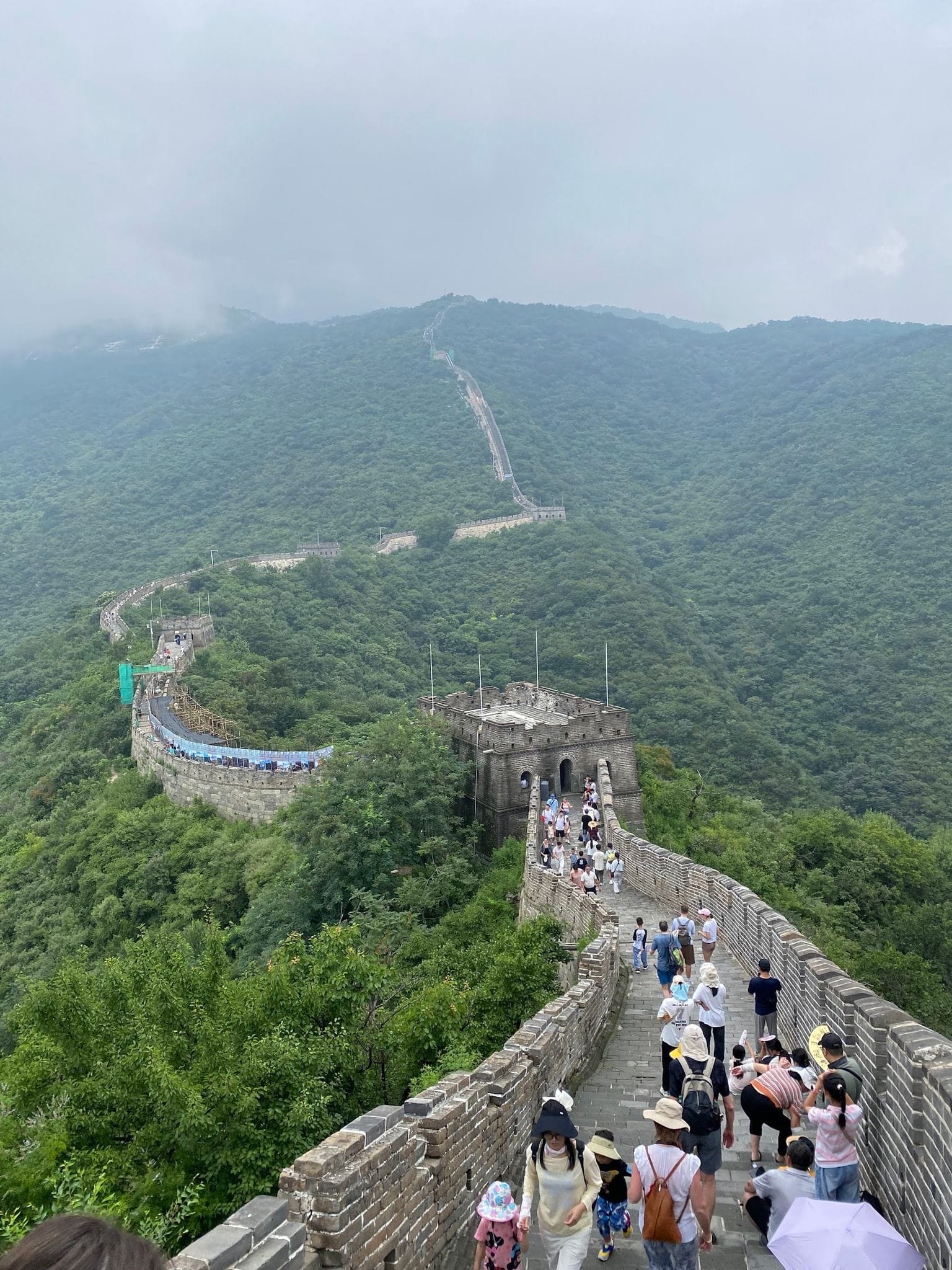
We landed in Beijing around 4 am with a 16-hour layover and, as it turned out, no internet. Google didn't work, our VPN wouldn't connect over the airport Wi-Fi, and the only navigation we had was reading map app names off posters. A few hours later we were standing on the Great Wall of China — on a free tour that starts right at the airport — and China became my 80th country. Four weeks later we came back for a second Beijing layover, fully prepared, and it felt like a different city.
Both stops were the bookends of my 4-week Asia trip: one Air China ticket from Warsaw to Ho Chi Minh City and back, with a long stop in Beijing each way.
China has about 1.4 billion people, and Beijing alone had more than 21.8 million residents at the 2020 census. Fun fact: the whole country runs on a single time zone, UTC+8, although it spans almost five geographical ones.
Beijing transit visa-free on a Ukrainian passport
I didn't need a visa for either layover. Ukraine is on the list for China's 240-hour visa-free transit: arrive from one country, continue to a third one on a ticket with a confirmed seat and date, and you can leave the airport and stay in the permitted areas for up to 10 days. Warsaw → Beijing → Ho Chi Minh City fits, and so does the way back. Flying out and back to the same country doesn't.
There's a separate immigration line for visa-free transit at PEK, and it took about 10–20 minutes: a couple of questions about where we were headed next, then through. My passport is already full of visas, which probably didn't hurt, but everyone else in that line moved just as fast — nobody got pulled aside.
Internet in China for tourists: the first hours
My first thought after landing was: how do we even do anything here? The Great Firewall blocks Google, and with it the maps, mail and search I use without thinking. Before the trip we had read exactly one thing — about a free tour booth in the airport — and nothing about getting online.
So we asked at the info desk what to use for navigation. The guy first suggested a local Wi-Fi network, which didn't work. Then he suggested turning my VPN off. That did it: the airport Wi-Fi let us download Amap for navigation, and later that day we found and bought an eSIM online — not the Trip.com one yet, that came on the second layover.
The funny part: from inside that firewall, my own website loaded just fine. The next day I joked on Threads that the Great Firewall blocks almost the entire internet, but not my personal website. The explanation is boring — censorship targets specific political, social or competing commercial sites, not everything. Still, for someone who has written about how much of my life sits in Google, a day without it was a strange experiment.
Free Great Wall tour from Beijing airport
The one thing we did read: there's a booth in the airport offering free tours to the Great Wall and around the city. The Wall is a long drive from the airport, so a free ride there sounded almost too good.
It's real. Trip.com Group launched the Free Layover Tour Service at Beijing Capital International Airport in December 2024; on Trip.com it's called Beijing Express. International transit passengers with 8+ hours of layover sign up by the Terminal 3 international arrivals exit, next to a Manner coffee shop — no pre-booking, first come, first served. There are two half-day routes, both starting and ending at the airport: the Great Wall (7:30–13:00) and a city tour (13:30–21:00) through the Temple of Heaven, Qianmen Street and Tiananmen Square. Transport, a guide, attraction tickets and internet are included; meals aren't.
In practice, the compact blue booth right after the exit wasn't staffed yet when we got there. We waited close to an hour until someone showed up and registered us, then another hour for the first — and only — bus of the morning to leave.
Our bus went to Mutianyu, the most tourist-ready of the restored sections: about 70 km from central Beijing, in Huairou District, with a cable car (we took it both ways) and a toboggan track for the way down. In late July it was hot and crowded — summer in Beijing, and everyone had the same idea. That day I wrote on Instagram that it turned out really hot and crowded, and I stand by it. What I didn't expect was who the crowd was: something like 9 in 10 people around us looked Chinese. I'd assumed the Great Wall would be wall-to-wall foreigners, and instead I was watching domestic tourism at a scale that's hard to picture from Europe. And no, you can't see the Wall from the Moon: from there it would look like a human hair seen from 3 km away.
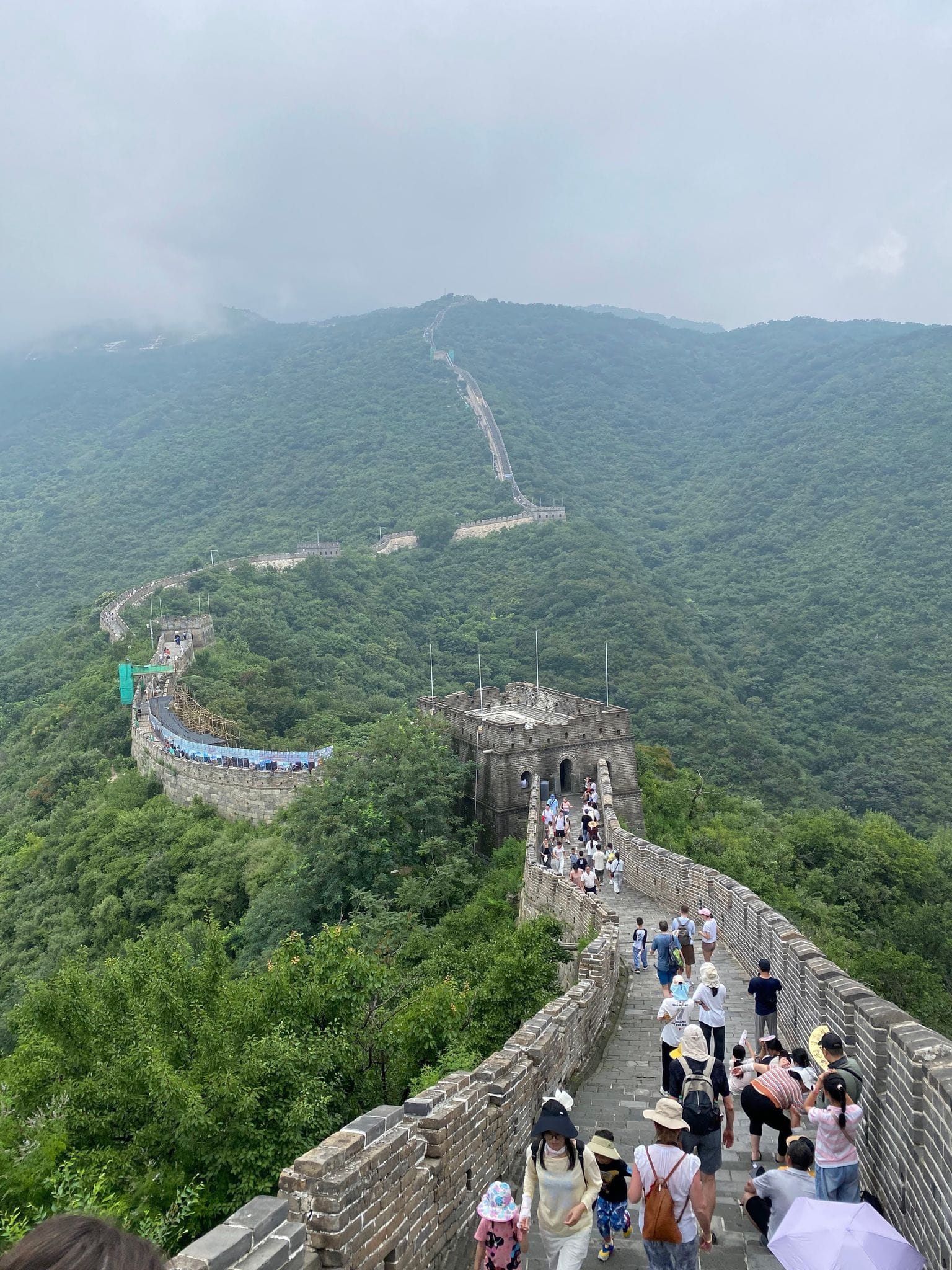
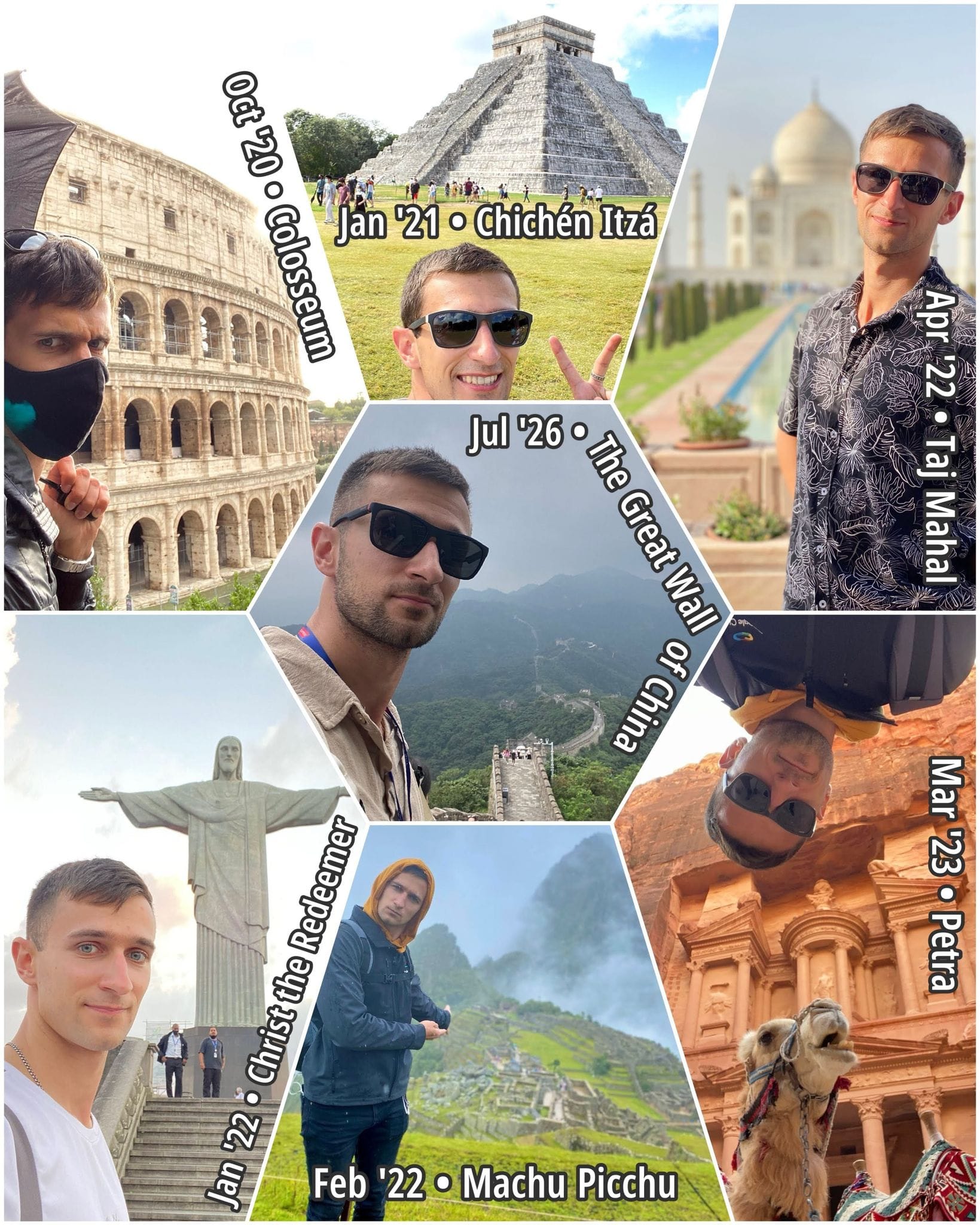
The tour took about 6 hours, and it closed a list I'd been collecting since 2020: the New 7 Wonders of the World, chosen by a public vote announced in 2007. The Great Wall was my last one, after the Colosseum and Chichén Itzá in 2020, Christ the Redeemer, Machu Picchu and the Taj Mahal in 2022, and Petra in 2023. 7/7, done.
Walking Beijing instead of the Forbidden City
After the Wall we joined the second free route into the city, and the guide walked with us for a few minutes before leaving us to it. We skipped the Forbidden City, the place everyone buys tickets for on the Palace Museum's website. After a night flight and a morning on the Wall, we just wanted to walk around on our own.
Honestly, that first walk reminded me of my hometown, Kyiv. Older buildings, older streets, not much that felt new. It was hot, we got tired, and after a few hours we headed back to the airport for the evening flight to Ho Chi Minh City.

Beijing layover, take two: the CBD and CCTV Headquarters
On August 26 we landed from Ho Chi Minh City at 11:10, and this time we already had a Trip.com eSIM. As I remember, it was a few gigabytes a day for about a dollar, when other eSIM apps wanted around $6 for a single gigabyte. I'm not affiliated with Trip.com; between the free tour and the eSIM, they simply saved both of our Beijing stops.
Get a roaming eSIM before you land in China. Its traffic goes through gateways outside mainland China, so Google Maps, WhatsApp and Instagram work without a VPN — and you skip the airport Wi-Fi puzzle entirely.
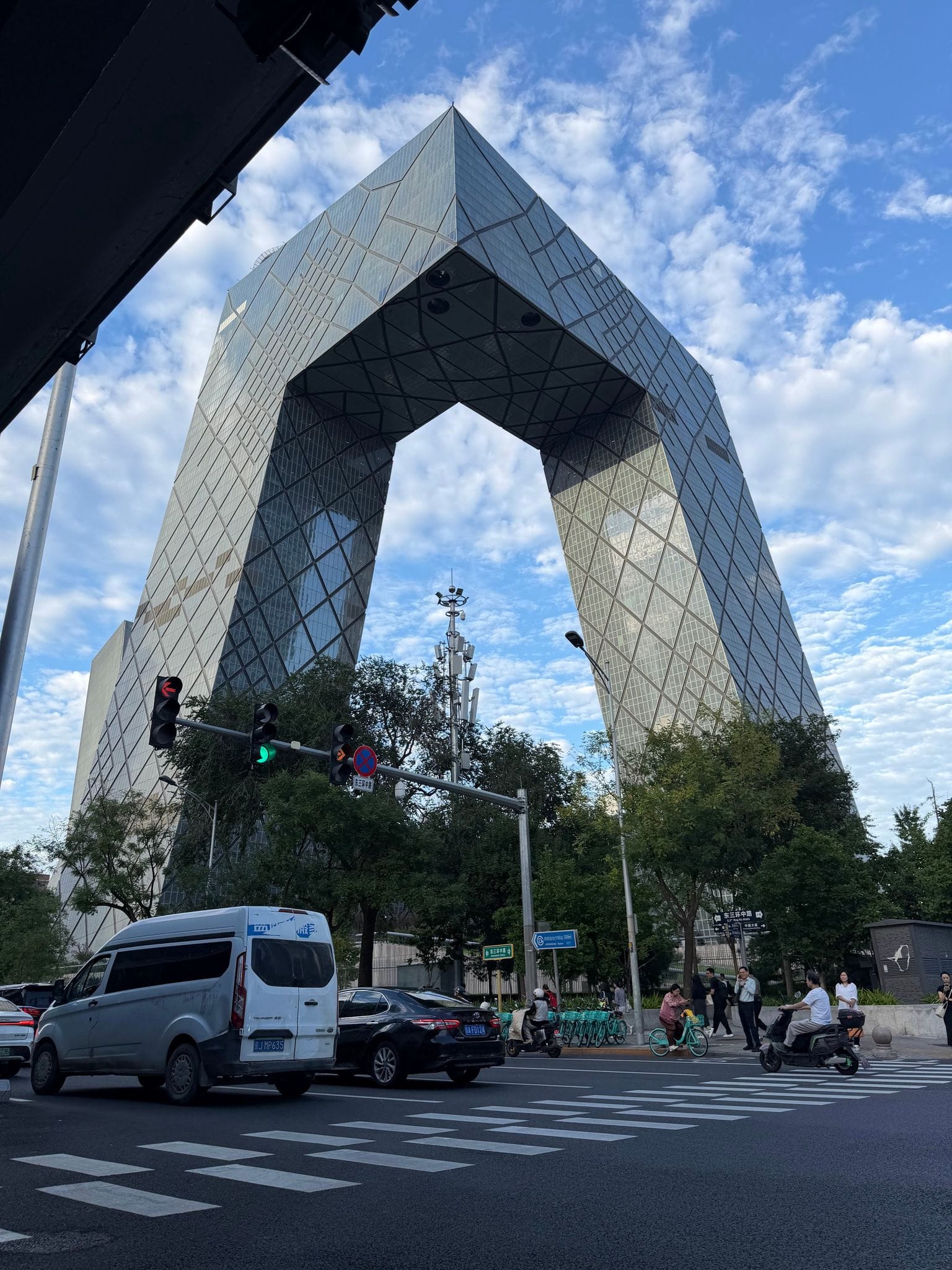
We went straight to the Beijing CBD, the modern side of the city. Its landmark is CCTV Headquarters: two leaning towers joined into a loop, 234 meters tall, designed by Rem Koolhaas and Ole Scheeren of OMA and completed in 2012. Locals call it "big pants" (大裤衩, dà kùchǎ), and once you see it from the right angle, you can't unsee it.
We started in Tuanjiehu Park, just north of it: a pond with small boats you can rent, and people dancing in the open air. Maybe it was an event, maybe it's a regular afternoon there — I'm not sure. Either way, it was lovely to watch.

Then we went up to a top-floor bar — I think it was at China World Summit Wing, though I'm not fully sure — for a cocktail with a view. The cocktails ran about $9 each; the air was hazy, and the windows weren't very clean either — a few nice pictures, an okay experience.

In the evening we did some shopping and went back to the airport. The lounge there — accessed with LoungeKey, the same card benefit I used all trip — included a 30-minute massage, after which you can stay another hour to rest. We used that hour to sleep, then found some very spicy Chinese food at a food court in the terminal and took the night flight to Warsaw.
The first time, Beijing felt like Kyiv. The second time — cool buildings, beautiful streets, the right SIM card and nothing to figure out — it was flawless.
Practical Notes
- Visa-free transit: in 2026, a Ukrainian passport qualified for 240-hour visa-free transit as long as the onward flight went to a third country. Keep the onward booking handy.
- Free Great Wall tour: Beijing Express needs 8+ hours of layover at Beijing Capital (PEK). Registration opens an hour before each departure — 6:30 for the Great Wall, 12:30 for the city tour. Come early — we waited close to an hour for the booth to open, then another hour for the bus to leave.
- Which section of the Wall: ours went to Mutianyu — cable car both ways, or a toboggan run if you want the way down to be faster. Trip.com's page lists Mutianyu, while the 2024 launch announcements said Badaling, so ask at the counter if it matters to you.
- Internet: buy a roaming eSIM before you land. If you're stuck on airport Wi-Fi with a VPN that won't connect, try turning the VPN off to download a local map app.
- Summer: the Great Wall in July is hot and crowded, and meals aren't part of the free tour. Bring water and something to eat.
- Forbidden City: tickets are sold online on the Palace Museum's website, so check availability before you plan around it.
- Payment: Alipay worked once I bound an international card to it. WeChat Pay was a pain — the SMS confirmation kept failing — so install and set it up before your trip, not after.
- Power banks: flights in China want a CCC mark on your power bank. Shops in Taipei and Seoul didn't carry CCC-marked ones when I checked, so I ended up buying a CCC-marked 25,000 mAh Anker in Japan instead.
China has a reputation for being hard for tourists. After the first layover, I'd have agreed. After the second, I'm not sure anymore — I think it mostly comes down to the first 30 minutes at the airport and whether the right SIM is already in your phone :)